Questions and Answers

touch typing

Don’t Take Our Word for It: Validate the Research Yourself

In education, we are often asked to pivot based on the latest policy shift, educational trend, or political backlash. With screen-time caps sweeping across Australian jurisdictions, it is easy to assume that all digital engagement should be rolled back. But as educators, policy documents, and cognitive science make clear, throwing the baby out with the bathwater is counterproductive.

You don’t need to take EdAlive’s word for the data linking touch-typing fluency to NAPLAN performance, cognitive load reduction, and curriculum compliance. The evidence is entirely public, peer-reviewed, and grounded in official government frameworks. To help you cross-check these claims, interrogate the research, and evaluate your own school’s digital strategy, we have compiled a list of comprehensive, double-barreled research questions.

To view an answer

Simply click any of the questions below to search Google and find the primary sources, reports, and curriculum documents for yourself. Sometimes Google will not generate an answer and simply display a series of source articles. If this happens, try again or try copying the question and pasting it into Google.

Curriculum Mandates, Alignment & Policy Questions

  1. Is the explicit teaching of touch typing the highest and best use of capped classroom screen-time budgets, and if so, how does it redeem device minutes, why is it mandatory, and what year levels should it be targeted across primary school?
  2. What does the Australian Curriculum Version 9.0 Literacy general capability progression state regarding keyboarding automaticity and its alignment to year levels, and how does this interact with the capping of screen time in Victoria and NSW?
  3. How do NSW Department of Education curriculum requirements align explicit keyboarding instruction and digital transcription automaticity with modern classroom screen-time caps, and what resources support teachers in delivering them?
  4. How does the Victorian Curriculum Version 2.0 structure digital composition and handwriting fluency across primary school levels, and why has explicit typing terminology shifted between curriculum versions?
  5. What did the 2020 NAPLAN Review conclude regarding the necessity of explicit keyboarding instruction for equitable participation in online writing assessments, and how does this address systemic equity gaps?
  6. What are the specific requirements and design differences between ACARA Version 8.4 (HwK sub-element) and Version 9.0 regarding digital transcription progression, and how do they alter classroom planning?
  1. How do the emerging screen-time caps across various Australian states interact with schools’ approaches to developing dual fluency in both digital keyboarding and handwriting?
  2. If students have missed obtaining automaticity in typing skills by year 6 is it necessary for students in higher grades to spend time establishing these skills? Also, as students learn at different rates should typing tuition extend beyond Year 6?

Cognitive Load, Automaticity & Literacy Impact questions

  1. How does John Sweller’s Cognitive Load Theory explain the impact of slow “hunt-and-peck” typing versus touch-typing automaticity on working memory, and does this differ when students transition from paper-based to screen-based composition?

  2. Why does ACARA classify handwriting and keyboarding as a “constrained skill” within the National Literacy Learning Progression, and does this mean its instruction permanently terminates once automaticity is achieved?

  3. How do the 2024 and 2025 OECD reports (such as PISA in Focus and digital technology literature reviews) distinguish between passive media consumption and active digital transcription, and what evidence do they provide regarding explicit keyboarding instruction for student literacy?

  4. Why does achieving touch-typing fluency bypass the long-term instructional time drain of unconstrained skills like reading comprehension and writing craft, and how does it free working memory for higher-order ideation?

  5. How does achieving touch-typing automaticity shift transcription from conscious visual searching to procedural muscle memory in the basal ganglia, and what direct effect does this cognitive bandwidth liberation have on student literacy levels and writing complexity?

  6. What evidence links “hunt-and-peck” typing speeds (10–15 WPM) to cognitive fatigue and writing avoidance in primary students, and how does explicit typing instruction prevent literacy degradation under modern screen-time caps?

Keyboarding Myths, Instructional Credibility & Pedagogy questions

  1. How do the three pervasive myths of touch typing—that children learn by “osmosis” as digital natives, that all screen time is equal, and that cutting typing saves cognitive energy—misunderstand John Sweller’s Cognitive Load Theory, and what impact does unmonitored typing have on working memory?

  2. How do misconceptions about screen time lump active, motor-driven touch-typing practice in with passive media consumption, and why is explicit keyboard instruction essential to prevent students from hitting a cognitive bottleneck during online NAPLAN assessments?
  3. What percentage of primary and secondary teachers reported feeling unprepared to teach keyboarding skills in the 2018 Australian Writing Survey?

Empirical Research, NAPLAN & School Evidence questions

  1. What are the key findings of Dr. Anabela Malpique’s 2024 study in Western Australian schools regarding keyboarding automaticity and writing quality, and how do they inform whether handwriting and touch-typing should be taught sequentially or concurrently?

  2. What empirical evidence links touch-typing fluency speed thresholds (such as 18 WPM) to NAPLAN Online Writing Task outcomes across 99 Australian schools, and how does this correlate with similar schools’ benchmarks?

  3. What are the findings of Connelly, Gee, and Walsh (2007) regarding children’s handwriting versus keyboarding speeds, and what implications do they hold for word-processor utilisation in primary classrooms?

  4. What did the NSW Centre for Education Statistics and Evaluation (CESE) discover about median Year 3 student typing speeds and their relationship to computer-based writing scores, and what monitoring recommendations were made for schools?

  5. What did Gahshan and Weintraub’s 2024 Grade 4 intervention study conclude regarding structured typing instruction and word-processing performance, and how reproducible are these gains in larger cohorts?

Typing Tournament related questions

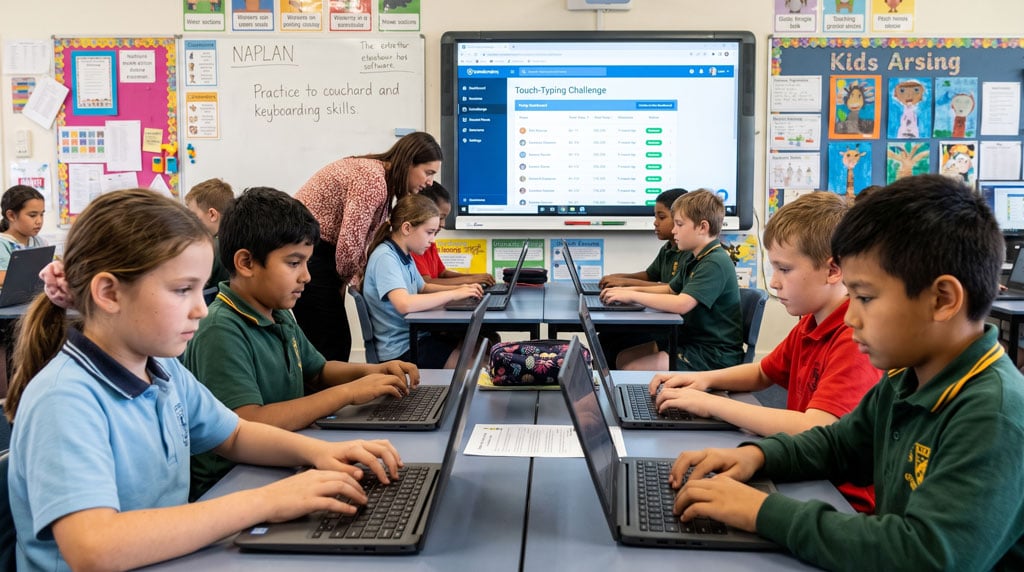
  1. How does Typing Tournament’s structured progression data demonstrate the rate at which students build typing speed (such as gaining ~6 WPM per term with 30 minutes of weekly practice), and how does mastery-gating ensure long-term muscle memory retention?

  2. What empirical data connects Typing Tournament implementation across 99 Australian schools to the +7.1 mark advantage on the NAPLAN Online Writing Task, and how does reaching the 18 WPM fluency threshold transform student performance?

  3. How do the free resources and curriculum mapping available on the EdAlive Typing Tournament Curriculum Hub combine with the to help schools measure fluency rates and achieve curriculum automaticity?  Guide to Best Classroom Practice for the Teaching of Touch Typing

  4. How does Typing Tournament’s methodology transition students from initial key-location drills to advanced speed thresholds (22 to 35+ WPM), and what specific impact does this have on completing timed writing tasks under strict screen-time caps?

  5. What specific teacher reporting dashboards and progress-tracking metrics does Typing Tournament provide to monitor individual and cohort WPM, accuracy, and practice duration in alignment with CESE recommendations?


  6. How does Typing Tournament’s software-driven speed and accuracy tracking pair with direct teacher supervision of posture, technique, and home-row placement to intercept poor habits early?

Related Articles

50 Word summary 

For some students, handwriting can obstruct rather than express their ideas. Personal accounts and a small study of children with dysgraphia describe how keyboards can