Questions and Answers
Don’t Take Our Word for It: Validate the Research Yourself In education, we are often asked to pivot based on the latest policy shift, educational

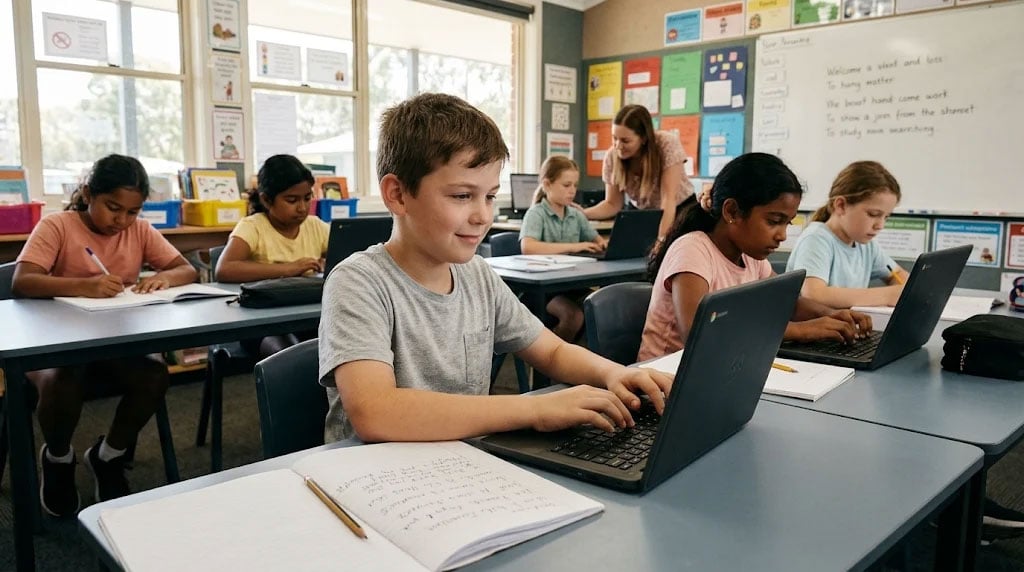
For some students, handwriting can obstruct rather than express their ideas. Personal accounts and a small study of children with dysgraphia describe how keyboards can make writing easier—but access alone is not enough. Students need explicit typing instruction and suitable digital tools. Schools should teach and assess both handwriting and keyboarding, ensuring that difficulty with one mode does not prevent students from demonstrating what they know.
For some students, handwriting is not simply slower than typing. It is a barrier between what they think and what they can show.
A student may understand the subject, have something worth saying and still struggle to get it onto paper. Handwriting may be painful, exhausting, slow or difficult to read. That difficulty can make writing feel like a test of hand control rather than a way to express thought.
A keyboard can change that experience.
Sunny Moraine, a writer with dysgraphia, describes handwriting as involving severe difficulty, illegible writing and painful hand cramps. She explains what changes when they type:
“When I write on a keyboard all of that goes away and everything flows wonderfully. I couldn’t write without a keyboard. Without a keyboard, I am probably not a writer at all.”
— Moraine, 2015
This is one person’s account, not evidence that every student with dysgraphia will experience the same effect. But it makes an important educational point: handwritten work may not show what a student can express when transcription is less of a barrier.
An unidentified first-person account by a writer describing dysgraphia similarly recounts years of painful handwriting, followed by the discovery that touch typing made written work possible without the same physical strain:
“It was like being given access to electric light for the first time.”
The writer describes asking to complete homework in the school typing laboratory because typing was so much easier than handwriting (Anthony, 2017). Again, this is personal testimony, not a controlled study. Its value is to show what an accessible keyboard can mean to an individual student—and why schools should not assume that handwriting alone is an adequate way to demonstrate learning.
There is also published research, though it is limited. Lie, O’Hare and Denwood (2000) surveyed teachers supporting 51 children with motor dysgraphia in Scotland. About 80 per cent had been issued a keyboard. Teachers reported that most children liked using it, and most thought it had benefited the children who used one.
The researchers included children’s comments about keyboards as reported by their teachers. These included:
“I can write what I want.”
“I find it easier to correct mistakes.”
“I waste less time.”
“I don’t get writer’s cramp.”
“I feel proud of my copy.”
These are not direct quotations from recorded child interviews: they were gathered through teacher questionnaires. The study was exploratory, and it also reported difficulties. The most frequent negative comment was that the child was not fast at typing; some felt different from their classmates, and some found the keys confusing.
That qualification strengthens rather than weakens the point. A keyboard is not automatically a solution. Providing one without teaching the student how to use it can leave the original problem partly unresolved—or replace it with another: slow, effortful hunt-and-peck typing.
For students who struggle with handwriting, a keyboard, word processor and appropriate accessibility tools can help them produce, revise and present work. Depending on the student and task, useful tools might include spellcheck, word prediction, text-to-speech, speech-to-text or digital dictionaries.
Those tools do not remove the need to teach. Spellcheck does not teach spelling; speech-to-text does not teach composition; a keyboard does not teach touch typing. Students still need instruction in keyboard technique, drafting, revision and the critical use of digital supports.
The distinction matters in classroom practice:
The goal is not to replace handwriting with technology. It is to ensure that difficulty with one mode does not prevent a student from demonstrating what they know in another.
A timed handwritten assessment rewards students whose handwriting is fluent and penalises those whose handwriting is slow, painful or difficult to read. A timed keyboarded assessment can similarly disadvantage students who have not been taught to type.
A change in NAPLAN mode may be made for legitimate reasons. But it does not, by itself, solve the transcription problem. Nor does it establish that handwritten assessment will be fairer for every student. The question should be which students can best demonstrate their composition in each mode—and whether schools have taught both modes well enough for the comparison to be meaningful.
Reasonable adjustments, such as extra time, a scribe or a computer, are important. But adjustments can depend on diagnosis, advocacy and local practice. They should complement, not replace, sound assessment design and explicit teaching.
Schools should also avoid assuming that children will learn keyboarding simply by using phones or other devices. Familiarity with tapping a small touchscreen is not the same as being able to produce and revise extended text on a keyboard.
Handwriting has an important role in literacy development and deserves explicit instruction. Keyboarding is also a necessary skill for study, employment and everyday life—and for some students, it is an essential means of putting ideas into written form.
Schools should:
The choice should not be between defending handwriting and enabling keyboarding. Students need both—and some need the keyboard in order to have their writing heard at all.