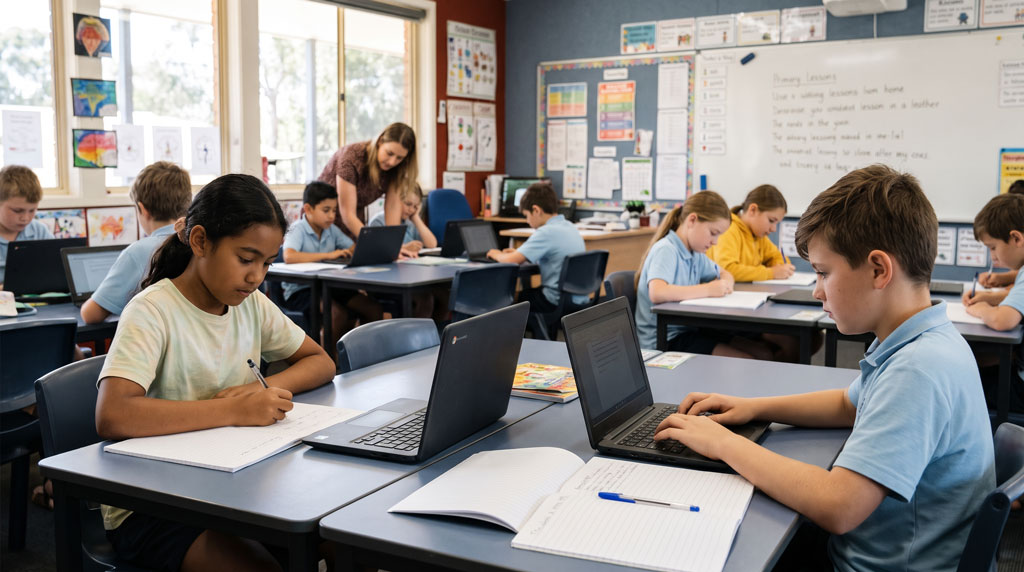
Across Australia, principals and teachers face conflicting signals. The November 2026 Education Ministers’ Meeting Communiqué and the federal policy paper A Digital Detox for Rebalancing Technology Use in Australian Schools announced that Year 5 NAPLAN writing will return to pen and paper by 2028, alongside a new Australian Schools Digital Detox Taskforce and state-level daily screen-time caps. Simultaneously, state and national curricula still expect primary schools to build digital literacy—and Year 7 and Year 9 NAPLAN writing remain digital pending review.
Unsurprisingly, many teachers do not know what to do. Should primary schools pack away keyboards and drop touch-typing instruction to meet screen limits? What happens to schools reliant on digital platforms for core reading and mathematics?
This article brings practical, evidence-based clarity to school leadership. Examining Australia’s split curriculum landscape—distinguishing between jurisdictions using the Australian Curriculum (v9.0) directly and those writing independent statutory syllabuses (NSW, Victoria, and Western Australia)—shows that achieving true Dual Fluency (automaticity in both handwriting and touch-typing) is more urgent than ever, and that schools must avoid hasty, hard-to-reverse cuts while directives mature.
1. The Source of Confusion: General Capabilities vs. Statutory Mandates
Teachers feel pulled in opposite directions because Australia operates under a split curriculum landscape where keyboarding obligations vary sharply across jurisdictions:
The Australian Curriculum (v9.0) & WA (SCSA): ACARA removed explicit software/keyboarding content descriptions from English content codes in AC v9.0, placing keyboarding into the Literacy General Capability (Handwriting and keyboarding progression) rather than a dedicated statutory English outcome. Western Australia’s revised syllabus similarly frames keyboarding through general capabilities. Without a statutory content code or a Year 5 NAPLAN online writing test, keyboarding has no guaranteed timetable protection.
New South Wales (NESA): NSW remains unique by encoding touch-typing and digital transcription explicitly into statutory English outcome codes (EN1-HANDW-01, EN2-HANDW-02, EN3-HANDW-02).
The Assessment Vacuum: Returning Year 5 writing to paper in 2028 removes the only de facto national measurement of primary typing proficiency—even though Year 5 reading, numeracy, spelling, grammar, and punctuation remain online, and Year 7 and Year 9 NAPLAN writing remain digital.
Unmeasured Drift: When an unassessed skill that sits merely as a General Capability collides with strict screen-time caps, teachers naturally drop it first—leaving students entering Year 7 with entrenched two-finger “hunt-and-peck” habits.
2. The Cognitive Science Imperative: CESE Evidence & Transcription Automaticity
School leaders must separate screen clutter from transcription automaticity. The pedagogical case for systematic keyboarding rests on Cognitive Load Theory (CLT) and the Simple View of Writing—frameworks championed by the NSW Centre for Education Statistics and Evaluation (CESE) (Cognitive Load Theory: Research that teachers really need to understand).
Working Memory Bottlenecks: As CESE research shows, human working memory has strictly limited capacity. Writing requires simultaneously managing transcription (motor execution) and composition (ideation, syntax, and structure). Without automated keyboarding, visual key-hunting consumes working memory and starves higher-order thinking.
Protection Against AI Dependency: A core pillar of the November 2026 communiqué and Digital Detox paper is preventing “cognitive stunting” from students offloading thinking to generative AI. Students struggling with physical typing friction are far more tempted to use AI shortcuts; automated typing removes that friction so they can compose independently.
3. The Screen-Minute Squeeze: Can Schools Keep Digital Reading and Maths Programs and Teach Digital Skills?
Many primary schools built daily literacy and numeracy rotations around commercial subscription platforms, alongside ad-hoc, ad-supported freeware and poorly designed online typing games characterised by low pedagogical quality and commercial distraction. Principals now ask whether they can keep these digital programs alongside mandatory digital skills inside new daily caps.
The honest answer is no—not as universal, whole-class daily rotations:
The Timetable Arithmetic Fails: Under strict caps—such as NSW’s 30-minute daily limit in Years 3–4 (150 minutes weekly)—a 20-minute literacy app rotation plus a 20-minute maths app rotation consumes 200 minutes weekly, exceeding the entire device budget before a student opens a word processor, conducts research, completes Digital Technologies tasks, or practises keyboarding. In K–2 (15 minutes/day in NSW; minimal use in Victoria), one daily app session exhausts 100% of the allocation.
Eliminating Wasteful Use & Low-Quality Freeware: Federal and state directives instruct schools to prioritise non-digital methods where they work best, using screens only where they offer clear learning benefits over non-digital alternatives. Much of the screen time currently spent on reading, maths, and unstructured keyboarding represents wasteful use—particularly reliance on advertising-sponsored free platforms that suffer from poor instructional design and commercial clutter. By contrast, printed decodable readers, physical books, maths workbooks, and concrete manipulatives teach reading and numeracy with zero screen fatigue and stronger retention. Because touch-typing cannot be learned on paper, spending scarce screen minutes on skills teachable on paper starves skills requiring a keyboard. Furthermore, K–2 teachers facing tight daily caps can build early spatial awareness and home-row familiarity off-screen using printed keyboard mats before students ever touch a device.
Practical Rebalancing: Schools should eliminate low-quality, ad-supported freeware entirely, return mainstream whole-class reading and maths practice to print, use weekly averaging to batch screen time for project work, and ring-fence 10–15 minutes, three to four times weekly for systematic, mastery-based touch-typing instruction.
4. The 2026–2028 Runway: Why Hasty Decisions Are a Strategic Mistake
The biggest danger during policy transitions is administrative overcorrection—prematurely cancelling typing programs ahead of 2028. The legislative timeline provides immediate clarity: there is ample time for directives to mature, and no mandate to abandon keyboarding.
Timeline Phase
National & State Policy Milestones
Strategic Counsel for School Leaders
Late 2026 (Current)
• Nov 2026 Communiqué & Digital Detox Paper: Ministers agree in principle to return Year 5 NAPLAN writing to paper by 2028 and restrict generative AI in primary schools.
• Digital Detox Taskforce established. | Hold steady; do not dismantle programs. No national screen caps are law yet. Reassure teachers that existing dual-fluency programs remain valid while auditing current screen-minute allocation. | | Throughout 2027 | • Transition & Maturation Year: Digital Detox Taskforce provides preliminary advice by mid-2027 and concludes its work by year-end.
• WA conducts classroom screen-time trials. | Reallocate, don’t eliminate. Cut low-quality freeware, transition mainstream reading and maths practice back to print, and ring-fence concise 10–15 minute daily blocks for systematic keyboarding while awaiting Taskforce findings. | | 2028 Onwards | • Full Enforcement: Year 5 NAPLAN writing moves to pen and paper; NSW screen-time limits become mandatory; ACARA advice on Years 7 & 9 writing and Years 3 & 5 numeracy matures. | Embed permanent Dual Fluency. Schools preserving systematic typing within rationed screen budgets will graduate cohorts ready for digital secondary schooling, avoiding a severe Year 7 literacy bottleneck.
5. State-by-State Clarity: Independent Syllabuses vs. AC v9.0 Jurisdictions
Part A: Independent Syllabus Jurisdictions (NSW, VIC, WA)
1. New South Wales (NESA English K–10 Syllabus)
Curriculum Architecture: NSW stands alone nationally by embedding keyboarding directly into statutory English outcome codes (EN1-HANDW-01, EN2-HANDW-02, EN3-HANDW-02) under Handwriting and digital transcription.
Screen Caps: From Term 1, 2027 (mandatory in 2028), NSW caps individual device use at 0 mins (preschool), up to 15 mins/day (K–2), up to 30 mins/day (Years 3–4), and up to 45 mins/day (Years 5–6).
Clarity for NSW Teachers:The CESE Paradox. NSW’s CESE research proves transcription automaticity lowers cognitive load. Under strict device limits, NSW schools cannot burn screen minutes on whole-class reading or maths apps. Ring-fencing 10 minutes daily for systematic touch-typing is easily defensible because there is no paper alternative—satisfying both screen caps and statutory transcription outcomes before Year 7.
2. Victoria (Victorian Curriculum F–10 Version 2.0)
Curriculum Architecture: Victoria writes its own curriculum. VCAA leaves keyboarding automaticity largely implicit in upper primary process descriptors (“using digital tools to create texts”), assuming typing speed without mandating touch-typing mechanics.
Screen Caps: From Term 1, 2027, Victorian government primary schools cap device usage at minimal use in F–2and a maximum of 90 minutes daily in Years 3–6.
Clarity for Victorian Teachers: Because VC 2.0 leaves automaticity implicit, teachers risk dropping structured typing drills once Year 5 NAPLAN moves to paper. However, Victoria’s policy permits digital use where it offers a “clear and significant benefit over a non-digital alternative”. Touch-typing qualifies because it cannot be learned off-screen.
3. Western Australia (WA Curriculum & Assessment Outline – SCSA)
Curriculum Architecture: SCSA adopts the Australian Curriculum framework, treating keyboarding via Literacy General Capabilities rather than explicit English content mandates.
Screen Caps: WA is piloting formal classroom screen-time limits in 2027.
Clarity for WA Teachers: School leaders should apply explicit direct-instruction principles (used successfully for phonics) to structured keyboarding blocks during this trial phase, ensuring reduced device exposure does not leave students digitally stranded in Year 7.
Part B: Australian Curriculum (v9.0) Jurisdictions (QLD, SA, TAS, ACT, NT)
In these five jurisdictions, keyboarding is governed directly by Australian Curriculum: English (v9.0) (focusing on multimodal composition) supported by the Handwriting and keyboarding General Capability progression:
Queensland (QLD): Decoupling Year 5 writing from screens risks pushing formal keyboarding out of primary school entirely. Deliberate primary scheduling remains essential to prevent an equity divide for students lacking home desktop computers.
South Australia (SA): With Year 5 writing returning to paper, teachers may feel relieved of test-prep pressure, allowing students to cement inefficient two-finger habits between Years 3 and 6 that hinder secondary performance.
Tasmania (TAS): Relying on ad-hoc digital exposure instead of structured typing modules widens the secondary readiness gap when students transition to digital high school assessments.
Australian Capital Territory (ACT) & Northern Territory (NT): High device saturation in the ACT makes structured touch-typing vital to prevent “hunt-and-peck” habits, while offline-capable typing instruction in the NT ensures remote students master physical hardware despite connectivity limits.
Clear Next Steps for Australian Schools
Once the noise is stripped away, the path forward is clear: the Digital Detox is a mandate to eliminate screen clutter, not foundational digital literacy. Whether operating under NESA’s explicit statutory transcription outcomes, Victoria’s implicit expectations, or AC v9.0’s General Capability framework, the practical need to teach keyboarding remains vital.
By eliminating low-quality freeware, shifting mainstream reading and maths practice back to print, and protecting brief, systematic instruction for skills strictly requiring a keyboard, schools can replace policy confusion with true Dual Fluency—equipping students with both pen-and-paper stamina for Year 5 and the automated typing fluency essential for secondary school and beyond.
References
National Policy & Ministerial Directives
Education Ministers’ Meeting (EMM). (2026, November). Communiqué. Australian Government Department of Education.
Australian Government Department of Education. (2026, November). A Digital Detox for Rebalancing Technology Use in Australian Schools. Canberra: Commonwealth of Australia.
Cognitive Science & Educational Research
Centre for Education Statistics and Evaluation (CESE). (2017). Cognitive Load Theory: Research that teachers really need to understand. Sydney: NSW Department of Education.
Centre for Education Statistics and Evaluation (CESE). (2018). Cognitive Load Theory in Practice: Examples for the classroom. Sydney: NSW Department of Education.
Berninger, V. W., & Amtmann, D. (2003). Preventing written expression disabilities through early and continuing assessment and intervention for handwriting and/or spelling problems: Research into practice. In H. L. Swanson, K. R. Harris, & S. Graham (Eds.), Handbook of Learning Disabilities (pp. 345–363). Guilford Press.
National & State Curriculum Authorities
Australian Curriculum, Assessment and Reporting Authority (ACARA). (2022). Australian Curriculum: English (Version 9.0) and National Literacy Learning Progression. Sydney: ACARA.
School Curriculum and Standards Authority (SCSA). (2024). Western Australian Curriculum and Assessment Outline: Pre-primary to Year 10 English. Perth: Government of Western Australia.
State & Territory Screen-Time & Digital Guidelines
NSW Department of Education. (2026, September). Screen time guidelines from Term 1 2027. Sydney: NSW Government.
Victorian Department of Education. (2026). Digital Learning in Primary Schools: Screen Time Caps and BYOD Phase-Out Policy. Melbourne: State Government of Victoria.
ACT Government. (2026, November). Statement on Digital Detox and Position on the use of AI in ACT public schools. Canberra: ACT Government.
About Typing Tournament
Typing Tournament is an Australian-developed, mastery-learning touch-typing program designed specifically for primary and secondary classrooms. Fully aligned with national and state curriculum outcomes and literacy objectives across every Australian jurisdiction, it is grounded in Cognitive Load Theory—using explicit, step-by-step scaffolding and brief 10-to-15-minute practice sessions to build genuine motor automaticity without overwhelming working memory or exceeding daily screen-time limits.
Experience it in your classrooms: Australian schools are invited to take a free, no-obligation 1-month school trial of Typing Tournament to see how easily systematic keyboarding fits within a balanced, Dual Fluency timetable.
For some students, handwriting can obstruct rather than express their ideas. Personal accounts and a small study of children with dysgraphia describe how keyboards can
How falling for the “zero-sum”, “osmosis”, and “all screens are equal” fallacies threatens student literacy—and how to plan for 2027. When policy pivots rapidly, stressed