The Writing Pendulum: Why the “Digital Detox” Won’t Fix Australia’s Literacy Crisis (And What Will)
Quick summary
The Core Conflict: Political rhetoric urges a return to pen and paper, but cognitive science shows the real problem isn’t screens—it is the cognitive load of unautomated handwriting and “hunt-and-peck” typing.
The Research Evidence: Neuroimaging confirms handwriting builds foundational literacy in K–2, while Australian studies (ECU, NSW CESE, and a 99-school NAPLAN study) prove that uninstructed typing cripples composition, whereas automated touch typing ( 18 to 20 WPM) unlocks +7.1 marks on NAPLAN Online writing
The Solution: Adopt an explicit, phased continuum—foundational penmanship in K–2, followed by structured, ST4S-approved touch typing with Typing Tournament in Years 3–6, retaining analog handwriting stamina for GenAI-secure senior exams.
The Classroom Whiplash
If you teach in an Australian school, you are likely experiencing policy whiplash.
A decade ago, the 2.4-billion Digital Education Revolution (DER) promised that 1:1 laptops and BYOD schemes would transform learning. Today, after years of flatlining NAPLAN writing scores and a two-decade slide down international PISA rankings, the political pendulum is swinging in reverse.
Federal Education Minister Jason Clare recently captured headlines by calling for a classroom “digital detox,” reminiscing that “when I was a kid there was a computer room at school; now they are everywhere,” and suggesting that NAPLAN writing could return to pen and paper. Concurrently, Victoria has capped primary screen time and phased out primary BYOD programs, while every state has banned mobile phones in schools.
Teachers are caught in an impossible crossfire:
You see Year 3 students struggle to hold a pencil, lacking the fine motor stamina for manual composition.
You watch Year 5 and 7 students hunch over keyboards, hunting and pecking with two fingers during timed digital assessments.
You prepare students for online national testing while knowing that senior exit examinations (HSC and VCE) remain firmly pen-and-paper.
A political “digital detox” sounds simple, but banning keyboards will not fix writing outcomes. The battle is not Pen vs. Keyboard—it is Automaticity vs. Cognitive Overload.
Cognitive Architecture and Empirical Evidence
Writing relies on two competing cognitive systems, explained by Berninger’s Simple View of Writing and John Sweller’s Cognitive Load Theory (CLT) (developed at UNSW):
Lower-Order Transcription: The physical mechanics of forming letters or striking keys, plus orthographic spelling retrieval.
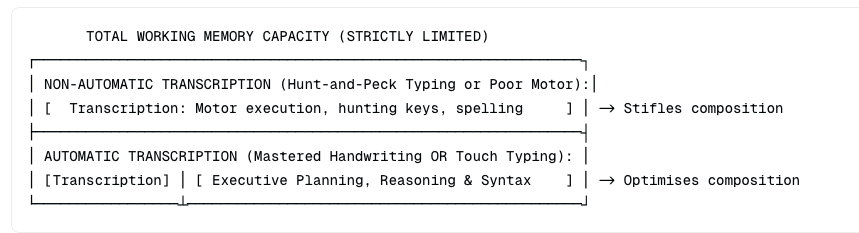
Higher-Order Composition: Idea generation, vocabulary selection, syntax, rhetorical structure, and editing. TOTAL WORKING MEMORY CAPACITY (STRICTLY LIMITED) ┌─────────────────────────────────────────────────────────────────┐ │ NON-AUTOMATIC TRANSCRIPTION (Hunt-and-Peck Typing or Poor Motor):│ │ [ Transcription: Motor execution, hunting keys, spelling ] │ -> Stifles composition ├─────────────────────────────────────────────────────────────────┤ │ AUTOMATIC TRANSCRIPTION (Mastered Handwriting OR Touch Typing): │ │ [Transcription] │ [ Executive Planning, Reasoning & Syntax ] │ -> Optimises composition └─────────────────┴───────────────────────────────────────────────┘
Working memory capacity is strictly limited. If transcription is not completely automated, working memory burns out simply putting letters on the page, leaving little mental bandwidth for higher-order thinking.
The Sensorimotor Superiority of Handwriting in K–2
In early childhood, manual letter formation is neurologically transformative: * The Alphabetic Motor Trace: Neuroimaging studies (fMRI by Dr. Karin James; high-density EEG by Audrey van der Meer) show that handwriting recruits rich sensorimotor brain networks that typing bypasses. Tracing distinct geometric strokes carves letter shapes into long-term memory, accelerating phoneme-grapheme integration, orthographic mapping, and early reading. * The Premature Keyboarding Trap: Pressing identical plastic keys provides zero tactile-motor differentiation. Striking keys before letter formation and spelling are secure fragments young children’s working memory. For K–2, the evidence is clear: the pen is irreplaceable.
The Middle-Primary Bottleneck and the “Mode Effect”
By Years 3 and 4, handwriting speed naturally plateaus between 10 and 13 WPM, rarely exceeding 20 WPM. As compositional demands surge, handwriting speed becomes a structural ceiling on thought.
Yet moving to uninstructed typing creates an equally destructive bottleneck:
The ECU Meta-Analysis (Malpique et al., 2023): Dr. Anabela Malpique and colleagues at Edith Cowan University examined primary writing outcomes and found students produced significantly higher-quality texts by hand than by keyboard (ES = 0.53). The cause was not an inherent flaw in computers, but an absence of keyboard automaticity: the children had never been taught to type.
The NSW CESE Findings: Research by the NSW Centre for Education Statistics and Evaluation (CESE) evaluating computer versus paper writing found primary students scored systematically lower on computers. Typing speed heavily bottlenecked test scores: an increase of just 5 WPM dramatically altered composition performance.
The Cognitive Cost of “Hunt-and-Peck”: Steve Graham’s meta-analyses on writing instruction establish that typing without formal training defaults to visually guided search-and-strike. Darting the eyes between screen and keyboard continually breaks visual attention and resets the phonological loop in working memory, impairing sentence construction.
The cure for poor writing isn’t abandoning technology—it is automating transcription in both modes.
A 4-Step Roadmap for Schools
To cut through political slogans and boost student writing, schools should adopt an explicit, research-aligned transcription framework.
1. Protect the Pen in K–2 (Foundational Phase)
Before children touch a keyboard for composition, manual letter formation must become second nature.
Prioritise explicit pencil grip, posture, and letter geometry: Dedicate daily instructional time to manual print literacy using systematic synthetic phonics.
Minimise digital screens during early writing: Avoid using tablets or laptops for early composition tasks. Let students build the sensorimotor neural connections that underpin reading and spelling.
Target early transcription automaticity: Ensure students can form letters fluently without conscious pause before introducing digital input devices.
2. Teach Structured Touch Typing in Years 3–6 (Transition Phase)
Do not assume students will learn to type by osmosis. The Australian Writing Survey found that most Australian teachers report feeling under-equipped to teach keyboarding mechanics, making an explicit instructional sequence essential.
Follow explicit instructional sequences: Align instruction with the NSW Department of Education’s Stage 2 and 3 sequences, scheduling at least three dedicated transcription sessions weekly.
Train muscle memory over sight: Teach correct home-row posture (ASDF / JKL;), floating wrists, and typing without looking down at the keys.
Target the 18–20 WPM threshold: Because handwriting averages 10 13 WPM, reaching 18 20 WPM on a keyboard removes the transcription bottleneck, setting students on track to hit 45 WPM by the end of primary school.
3. Deploy an ST4S-Approved Platform (Typing Tournament)
Avoid ad-funded consumer typing websites. Free consumer platforms serve commercial pop-ups, run third-party tracking scripts, and offer little pedagogical progression.
Use an ST4S-assessed learning tool:Typing Tournament(published by Australian publisher EdAlive) has undergone rigorous assessment under the national Safer Technologies 4 Schools (ST4S) framework and is approved for classroom use across all Australian state, territory, and non-government systems.
Rely on an ad-free, secure environment: Ensure student focus is protected from commercial banners and tracking while complying with strict Australian privacy standards.
Leverage systematic progression:Typing Tournament provides multi-row instruction, home-row finger mechanics, audio cues, and gamified reinforcement, taking the burden of teaching typing mechanics off the teacher.
4. Build Dual Fluency for Senior School and Generative AI
Senior secondary assessment requirements are diverging, demanding two distinct physical literacies.
Prepare for digital coursework and online NAPLAN: Fluent touch typing (45 60 WPM) allows students to keep their eyes on the screen, letting ideas flow directly into text for drafting, researching, and online exams.
Retain analog handwriting stamina for high-stakes exams: Because Generative AI (like ChatGPT) has compromised unproctored take-home tasks, university exam halls, the NSW HSC, and the Victorian VCE remain heavily pen-and-paper. TEQSA has formally advised universities to return to authenticated, invigilated formats.
Schedule timed, long-form handwritten responses: Ensure secondary students maintain physical hand endurance for multi-hour handwritten exams alongside high-speed keyboarding.
The 99-School NAPLAN Breakthrough
What happens when a school system moves past hunt-and-peck typing and explicitly teaches touch typing?
An empirical study led by Dr. Lindsay Brash analysed Year 5 cohorts across 99 Australian schools sitting the NAPLAN Online Writing Task. The study examined classrooms using Typing Tournament that reached functional typing fluency (18 20 WPM).
│ Typing Tournament Cohort (≥18–20 WPM) vs. "Similar Schools" Benchmark│
│ │
│ Average Performance Margin: +7.1 NAPLAN Marks │
│ Statistical Significance: p = 0.000002 │
│ Curricular Growth Equivalent: 1.1 to 1.6 School Terms of Learning │
│ │
│ Sub-Group Consistency: │
│ • Government Schools: +6.95 marks │
│ • Non-Government Schools: +7.23 marks │
│ • Metropolitan Schools: +6.52 marks │
│ • Regional / Remote Schools: +8.24 marks │
The results demonstrated how transcription automaticity frees student thinking:
Students using Typing Tournament for just 30 minutes per week gained an average of 6 WPM per term, or 24 WPM across a school year.
Cohorts achieving the 18–20 WPM threshold outperformed their socio-economically matched “Similar Schools” benchmarks by 7.1 marks on the Year 5 NAPLAN Writing Task.
In curricular terms, this advantage equals 1.1 to 1.6 school terms of additional writing growth.
The performance advantage was consistent across government schools (+6.95), non-government schools (+7.23), metropolitan areas (+6.52), and regional/remote schools (+8.24).
Reaching the higher threshold of 60 WPM produces a second qualitative leap in secondary years: the flow of thought while watching the screen is uninterrupted, generating superior prose and leaving time for structural self-editing.
When students automate the physical mechanics of typing, their working memory is freed to plan, construct, and refine their ideas.
Policy Realpolitik: Slogans vs. Syllabus Reality
Minister Clare’s rhetoric about returning to the computer rooms of the 1990s appeals to public nostalgia, but it conflicts directly with the operational policies of state education departments:
The Political Talking Point
The Operational Curriculum Reality
“Digital Detox” / Ban screens wholesale
Explicit Instructional Sequences: The NSW Department of Education and NESA mandate handwriting in K–2 alongside explicit keyboarding in Stages 2 and 3.
Return all tests to pen and paper
Dual Fluency Mandate: NAPLAN 5, 7, and 9 remain online; the National Assessment Program (NAP) ICT Literacy assessment requires proficient keyboarding.
Assume kids naturally know how to type
Structured Transcription Instruction: States are adopting the Science of Learning, acknowledging that typing mechanics must be taught explicitly, not left to chance.
Throwing out keyboards would only worsen digital inequity. According to national NAP ICT Literacy data, only 50% of Year 6 students and 37% of Year 10 students meet national proficient standards. Eliminating typing instruction punishes students who do not have computers at home. The solution is not digital abandonment, but structured, pedagogically sound instruction.
Conclusion & Next Steps
A political “digital detox” that sweeps keyboards out of classrooms does not solve writing struggles—it simply swaps one transcription bottleneck for another.
Our students do not need fewer tools. They need systematic instruction that builds automatic handwriting in K–2 and automated touch typing in Years 3–6. Dual transcription fluency gives students the cognitive freedom to focus on what matters most: the quality of their thoughts.
One Step You Can Try Tomorrow
Audit your middle-primary writing block. Are your students looking at the screen while composing digital text, or are their heads bobbing between screen and keys?
Introduce just two 15-minute weekly sessions of structured, ST4S-approved touch typing using Typing Tournament. In a single term, your students can gain 6 WPM in transcription speed—unlocking the cognitive bandwidth they need to write with clarity, confidence, and flair.
As students progress beyond the foundational basics, the requirements for effective spelling instruction shift from simple sound–letter matching to a more complex understanding of word
The journey through the September 2025 Literacy Hub Phonics Progression begins with the critical transition from the Foundation Year into Year 1. During the Foundation