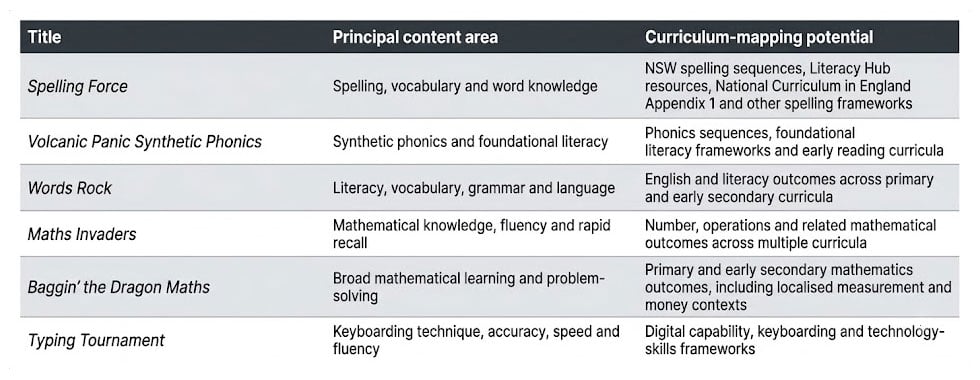
Their educational significance lies not simply in the number of questions, words and activities available, but in how that content has been classified, sequenced, and connected to curriculum outcomes. The breadth of the content allows the titles to support major English-language curricula while also providing a foundation against which many other curricula and syllabuses can be mapped.
From Curriculum Outcomes to Fine-Grained Learning Sequences
The initial EdAlive activity sets were developed over many years through a systematic deconstruction of major curriculum frameworks, including:
the Australian Curriculum [2];
the NSW syllabuses [3];
the National Curriculum in England [4];
the Common Core State Standards from the United States [5]; and
the Singapore curriculum [6].
This process involved breaking broad curriculum outcomes into smaller components that could be taught, practised and assessed through individual digital activities. The resulting EdAlive sequences are therefore substantially more fine-grained than a conventional curriculum or syllabus.
National and state syllabuses are generally written to describe what students should know and be able to do across a year, stage or grade band. They do not always specify every intermediate instructional step required to move a learner from one outcome to the next. EdAlive’s underlying sequences address this issue by decomposing broad outcomes into smaller increments and arranging them in an explicitly didactic order [1].
These internal sequences can identify:
prerequisite knowledge and skills;
intermediate steps between curriculum outcomes;
gradual increases in complexity;
opportunities for consolidation;
points at which additional practice may be required; and
evidence that a learner is ready to progress.
Consequently, EdAlive’s content is not simply a large question bank. It is a structured educational resource in which questions and activities occupy defined positions within teachable learning progressions.
Breadth and Volume of Content
Across the six titles, students can access many thousands of questions and learning activities. This breadth allows the products to address substantial portions of primary and early secondary learning in spelling, phonics, vocabulary, grammar, language, mathematics and keyboarding [1].
The large content volume has several educational advantages. It permits:
repeated practice without excessive repetition of identical questions;
coverage of the same concept through varied examples;
selection of material at different levels of difficulty;
differentiated pathways for learners with different starting points;
reinforcement of prerequisite skills;
sustained use across several school years; and
mapping to multiple curricula without requiring a completely separate content collection for every jurisdiction.
The scope and granularity of the content mean that virtually any primary or early secondary curriculum from around the world can potentially be mapped to the existing EdAlive content [1]. The breadth of the content provides the educational raw material needed to create localised curriculum alignments. Such mapping would require an appropriate curriculum analysis and validation process.
Spelling Force: A 45,000-Word Vocabulary
Spelling Force provides a particularly strong illustration of the relationship between content scale and curriculum mapping. Its vocabulary contains approximately 45,000 words, giving it sufficient breadth to support spelling instruction across a wide range of ages, abilities, spelling patterns and curriculum contexts [1].
This extensive vocabulary makes it possible to map and organise word sets against resources and frameworks such as:
the NSW Suggested Instructional Sequence for Spelling [3];
the Australian Government’s Literacy Hub resources [7]; and
the National Curriculum in England: English programmes of study—Appendix 1: Spelling [4].
The National Curriculum in England document is sometimes abbreviated as “NCE English Appendix 1.” Its formal title is English programmes of study: key stages 1 and 2—National Curriculum in England, Appendix 1: Spelling [4].
A spelling curriculum may organise instruction around phoneme-grapheme relationships, orthographic patterns, morphology, etymology, prefixes, suffixes, word families, irregular words or age-related word lists. A vocabulary of approximately 45,000 words provides the depth needed to create multiple overlapping classifications rather than forcing every word into a single instructional category.
For example, words may be selected or grouped according to:
sound-letter relationships;
common spelling patterns;
syllable structures;
prefixes and suffixes;
inflectional and derivational morphology;
word origins;
high-frequency usage;
curriculum year or stage;
level of complexity; and
identified student need.
This means the same underlying vocabulary can support different curricular approaches. A word may be relevant to a NSW instructional sequence, a Literacy Hub teaching focus and a National Curriculum in England spelling requirement, while retaining its position within EdAlive’s more finely graduated internal progression.
Following adaptive leveling, Spelling Force can use this detailed content structure to present spelling material optimised for the learner’s demonstrated level. Mastery learning then manages practice and progression through the sequence [1].
Comparable Curriculum Mapping Across the Other Titles
The same content-design principle extends across the other five products, although the form of the content varies according to the subject.
Mathematics content
Maths Invaders and Baggin’ the Dragon Maths draw on fine-grained mathematics sequences developed through analysis of the Australian Curriculum, NSW syllabuses, the National Curriculum in England, the Common Core State Standards and Singapore curriculum materials [1][2][3][4][5][6].
Because mathematics curricula frequently express similar concepts through different grade placements, terminology and presentation conventions, fine-grained content classification is essential. A single EdAlive learning element can be linked to more than one curriculum statement, while a broad curriculum outcome can be represented by a sequence of multiple EdAlive elements.
The extensive content also makes it possible to address prerequisites that may not be explicitly stated in a grade-level syllabus. If a student cannot successfully complete an activity associated with a particular outcome, the system can draw on smaller preceding steps rather than merely repeating the same grade-level question.
Literacy and phonics content
Words Rock and Volcanic Panic Synthetic Phonics apply similar principles to language and early literacy. Their content can be classified against literacy and English frameworks while retaining EdAlive’s own finer-grained instructional sequence [1].
In synthetic phonics, didactic order is especially important. Letter-sound relationships, blending, segmenting and increasingly complex word structures need to be introduced in an intentional sequence. The content must therefore be organised not only by subject category but also according to prerequisite relationships and instructional readiness.
Keyboarding content
Typing Tournament differs from the other titles in its progression model. It uses mastery learning only, with level-based tests managing student advancement. It does not use the initial adaptive-leveling process employed by the other five titles [1].
Its keyboarding content is nevertheless organised into a detailed didactic sequence. New keys and combinations are introduced systematically, while accuracy, technique and fluency are developed through staged practice. Level-based tests determine whether students are ready to progress.
Localisation Through Alternative Content Sets
For many EdAlive titles, alternative content sets are available to accommodate differences between national and regional contexts [1]. As appropriate to the subject matter, these sets may use different combinations of:
SI or metric measurement;
imperial measurement;
dollars; and
pounds sterling.
This localisation is educationally important. A mathematical concept may be universal, but the units, currency symbols, terminology and everyday examples through which it is taught can vary considerably.
For example, measurement questions may use centimetres, metres and kilograms in one content set, while another may include inches, feet, yards or pounds. Money activities may use dollars in an Australian or other dollar-based context, while another set uses pounds and pence for learners in the United Kingdom.
Alternative content sets therefore allow the underlying mathematical progression to remain stable while the surface context is changed to suit the learner’s curriculum and experience. Depending on the intended jurisdiction, a mixture of SI and imperial units may be appropriate rather than exclusive use of one system.
Localisation is not limited to mathematics. Spelling and literacy products must also account for differences in English usage, vocabulary and spelling conventions. The scale of the underlying content makes it possible to select appropriate material without abandoning the common didactic structure.
Relationship to Personalised Adaptive Learning
The fine-grained organisation of the content is also what makes Personalised Adaptive Learning possible. Five titles—Spelling Force, Maths Invaders, Words Rock, Baggin’ the Dragon Maths and Volcanic Panic Synthetic Phonics—first level students adaptively and then move them into mastery learning [1].
The general process is:
The system gathers evidence of the learner’s current performance.
It identifies an appropriate position within the fine-grained content progression.
It selects material optimised for that learner’s demonstrated level.
The learner practises and consolidates the relevant skills.
Mastery evidence is used to manage subsequent progression.
Typing Tournament uses the second part of this model—mastery-based progression—but manages it through level tests rather than initial adaptive placement.
This approach is consistent with the Personalised Adaptive Learning principles articulated by CIET-NCERT, including initial assessment, customised learning paths, adaptive delivery, mastery, continuing feedback and informed teacher intervention [8].
Educational Significance for Publishers and Schools
The key strength of EdAlive’s content architecture is the combination of scale, coverage and instructional structure. Large quantities of questions are valuable only when they are educationally classified and sequenced. Conversely, a carefully designed sequence may be difficult to personalise if it contains too few examples or insufficient content variation.
EdAlive brings these two requirements together:
extensive banks of questions, activities and vocabulary;
broad curriculum coverage;
detailed classification of content;
fine-grained internal learning progressions;
inbuilt didactic sequencing;
adaptive placement in five titles;
mastery-based progression across all six titles;
mapping to multiple curricula and syllabuses; and
localised content sets for measurement, currency and language conventions.
The underlying EdAlive sequences are more finely graduated than standard school curricula because they serve a different purpose. A curriculum describes expected learning at a system level; the EdAlive sequences translate those expectations into smaller instructional and assessment steps.
The resulting content architecture makes it feasible to map virtually any primary or early secondary curriculum to the existing collection, subject to local review and validation. It also enables schools and publishers to retain alignment with their prescribed curriculum while drawing on a much more detailed progression for teaching, practice, adaptation and mastery.
References
[1] EdAlive. Product and Curriculum Design Information for Spelling Force, Typing Tournament, Maths Invaders, Words Rock, Baggin’ the Dragon Maths and Volcanic Panic Synthetic Phonics. Publisher-supplied product information, 2026.
[8] Central Institute of Educational Technology, National Council of Educational Research and Training. Personalized Adaptive Learning: Technical Framework for Content Development. CIET-NCERT, SRG 2025.
As students progress beyond the foundational basics, the requirements for effective spelling instruction shift from simple sound–letter matching to a more complex understanding of word
The journey through the September 2025 Literacy Hub Phonics Progression begins with the critical transition from the Foundation Year into Year 1. During the Foundation