The November 2026 Education Ministers’ communiqué on the digital detox
Part 1: The communiqué — digital detox provisions Source: Education Ministers Meeting Communiqué, released 5 November 2026 for the meeting held on 2 November 2026.

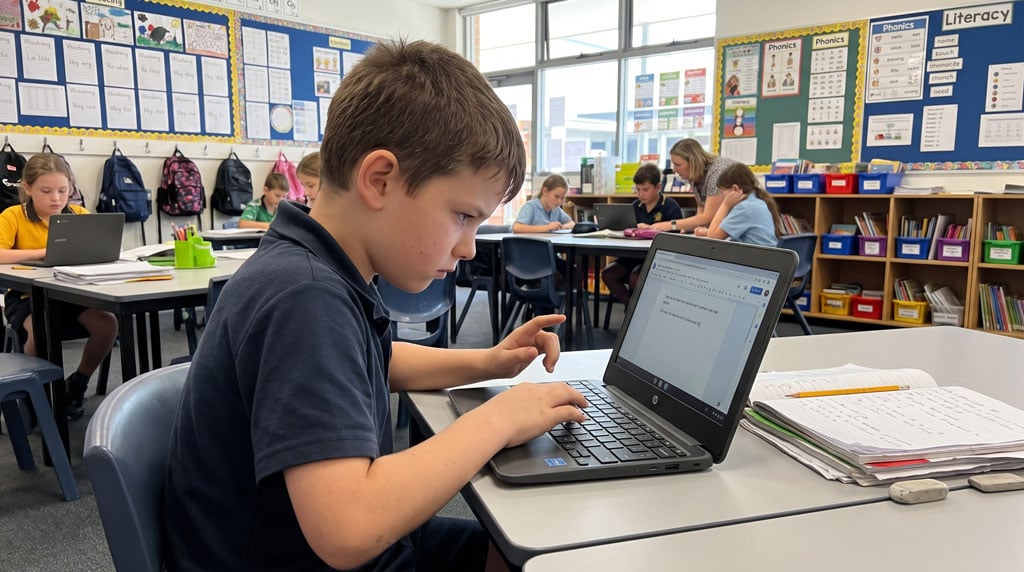
As educational policy swings back towards analogue fundamentals, a false binary has emerged in staffrooms and policy circles: that fixing student writing means choosing pen and paper over the keyboard.
A renewed focus on handwriting is justified. But a framework that attends only to handwriting risks two problems. It may disadvantage students who compose more effectively by keyboard. And it can overlook a larger group: students who, after years of leaving keyboard skill to exposure, are not yet fluent in either mode.
On 2 November 2026, education ministers agreed that Year 5 NAPLAN writing will return to handwriting in 2028, subject to further advice from ACARA on feasibility, costs and workload. Years 7 and 9 are undecided. These are not final decisions, and they should not be described as a ban on devices.
Any single-mode assessment can disadvantage students whose skills do not match it. A handwritten test can constrain students with dysgraphia, developmental coordination disorder or slow, painful handwriting (Beers et al., 2017; Khoury-Shaheen & Weintraub, 2026). A keyboarded test can constrain students who have never been taught to type.
It is also reasonable to ask whether a fluent typist is held back when asked to write by hand. That is a hypothesis, not an established finding. No study showing that fast typists are disadvantaged by a handwritten test could be found nor any data on how many such students exist. In the NSW CESE study, the median Year 5 typing speed was 15.4 words per minute (Lu et al., 2021), so very fast typists are rare in primary school. Primary handwriting is also slower, typically 10–13 words per minute (Brash, 2020). The question should be investigated, not assumed.
The stronger concern is students who are not yet fluent in either handwriting or keyboarding. For decades, students were expected to learn keyboard skills through exposure to devices. The evidence suggests exposure is not enough. In CESE’s study, most participating schools did not explicitly teach keyboarding, and median typing speeds in Years 2 to 5 ranged from 5.3 to 15.4 words per minute (Lu et al., 2021). Teachers surveyed nationally reported little training and little time for keyboarding instruction (Malpique et al., 2025).
Cognitive load theory offers a plausible explanation for why this matters. Working memory is limited, and tasks that must be consciously managed compete for it (Sweller, 1988). A student who must search for each key while holding a sentence in mind may have less capacity for ideas, sentence structure and revision. Automaticity, in the sense of LaBerge and Samuels (1974), frees attention for higher-level processing. Applying this to typing is an inference from the theory, not a finding of those papers. Australian research is consistent with it: in a study of 544 Year 2 students, keyboarding automaticity was associated with the quality and productivity of computer-based writing, alongside spelling and reading (Malpique et al., 2025). That is an association, not proof that faster typing causes better writing.
Claims that slow typing leads to writing avoidance or literacy fatigue remain hypotheses. No study that measures them against keyboard fluency could be found.
The practical response is not to choose a mode, but to teach both deliberately.
The proposed benchmarks and the long-term effects of instruction still need testing. But the policy conclusion does not depend on settling every question: teach handwriting, teach keyboarding, and avoid treating either as a substitute for the other.
Beers, S. F., Mickail, T., Abbott, R., & Berninger, V. (2017). Effects of transcription ability and transcription mode on translation. Journal of Writing Research, 9(1), 1–25. https://doi.org/10.17239/jowr-2017.09.01.01
Brash, L. (2020). Full research report: Keyboard ability significantly boosts NAPLAN results. EdAlive. https://www.edalive.com/full-research-report-keyboard-ability-significantly-boosts-naplan-results/ (developer-published; not peer-reviewed)
James, K. H., & Engelhardt, L. (2012). The effects of handwriting experience on functional brain development in pre-literate children. Trends in Neuroscience and Education, 1(1), 32–42. https://doi.org/10.1016/j.tine.2012.08.001
Khoury-Shaheen, R., & Weintraub, N. (2026). Keyboarding and handwriting in school students with developmental coordination disorder. Reading and Writing, 39(2), 515–527. https://doi.org/10.1007/s11145-025-10694-0
LaBerge, D., & Samuels, S. J. (1974). Toward a theory of automatic information processing in reading. Cognitive Psychology, 6(2), 293–323. https://doi.org/10.1016⁄0010-0285(74)90015-2
Lu, L., Turnbull, M., Wan, W.-Y., Rickard, K., & Hamilton, L. (2021). Are writing scores from online writing tests for primary students comparable to scores from paper-based tests? Centre for Education Statistics and Evaluation, NSW Department of Education. https://education.nsw.gov.au/content/dam/main-education/about-us/educational-data/cese/2021-online-writing-tests-for-primary-students.pdf (government research report; not peer-reviewed)
Malpique, A. A., Asil, M., Pino-Pasternak, D., Ledger, S., & Teo, T. (2025). The contributions of transcription skills to paper-based and computer-based text composing in the early years. Reading and Writing, 38(4), 911–945. https://doi.org/10.1007/s11145-024-10543-6
Malpique, A. A., Valcan, D., Pino-Pasternak, D., & Ledger, S. (2025). Teaching computer-based writing: Primary teachers’ preparation, self-efficacy, and instructional practices. The Australian Educational Researcher, 52(6), 4555–4580. https://doi.org/10.1007/s13384-025-00910-9
Santangelo, T., & Graham, S. (2016). A comprehensive meta-analysis of handwriting instruction. Educational Psychology Review, 28(2), 225–265. https://doi.org/10.1007/s10648-015-9335-1
Sweller, J. (1988). Cognitive load during problem solving: Effects on learning. Cognitive Science, 12(2), 257–285. https://doi.org/10.1207/s15516709cog1202_4
Education Ministers Meeting. (2026, 5 November). Communiqué – Education Ministers Meeting – Monday 2 November 2026. https://www.education.gov.au/education-ministers-meeting/resources/communiqus-education-ministers-meetings-2026