The Digital Advantage: Why Interactive Learning Outpaces Paper
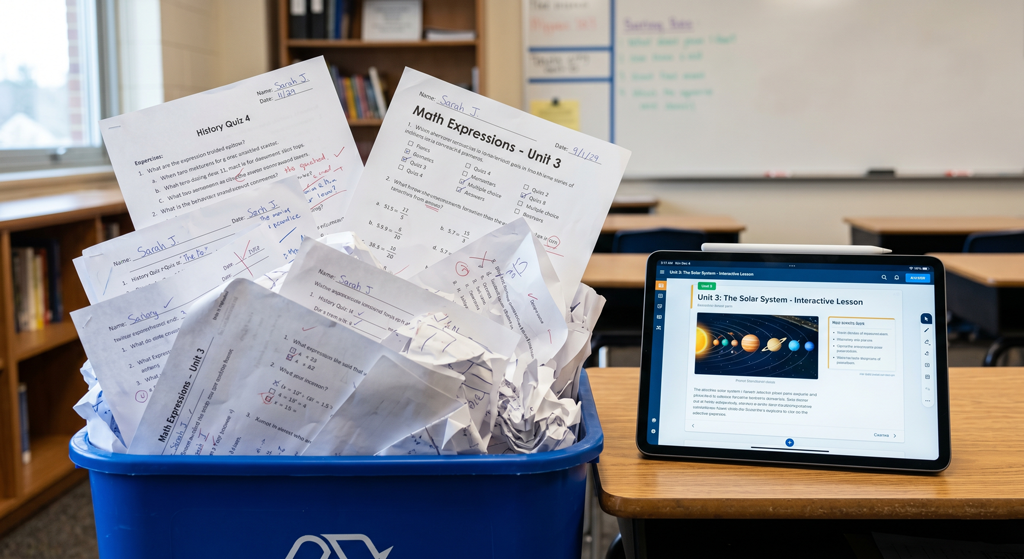
For many years, the standard Australian classroom relied on the physical workbook as the ultimate authority for daily practice. While these books provided a structured path, they lacked the one thing that modern students need most: responsiveness. The static nature of paper means that a student is often working in a vacuum, with no way to know if their logic is sound until long after the task is finished. This is where modern online courses have created a significant pedagogical shift. By moving the learning process into a digital, game-based environment, we provide a level of interaction that a worksheet simply cannot replicate. When a child engages with their studies through a screen, they are entering a two-way conversation with the content, where every action produces an immediate reaction.
The failure of traditional worksheets often stems from the “one-way” flow of information. The paper asks a question, the student provides an answer, and then… nothing happens. This lack of engagement is why so many children find maths to be a dry and uninspiring subject. By contrast, the best online courses are designed to be “sticky”—meaning they keep the student’s attention through constant feedback and rewards. In a system like Maths Invaders Online, the student is an active protagonist in a space-themed mission. Every correct calculation is a successful blast against an invader, making the online course experience feel like a continuous series of achievements rather than a list of chores.
The Cognitive Benefits of Dynamic Feedback
In educational theory, the speed of feedback is a primary predictor of learning success. If a student is allowed to repeat a mistake ten times on a worksheet, they have effectively “learned” the wrong way to do it. Correcting that ingrained error later is much harder than preventing it in the first place. High-quality online courses eliminate this risk through “instant remediation.” When a student makes an error in Maths Invaders Online, the system immediately highlights the mistake and shows the correct path. This ensures that the student’s online study time is always building toward accurate mastery.
This dynamic response is what allows for the development of “automaticity”—the ability to recall number facts without hesitation. Because the game environment is fast-paced, it encourages the brain to find the most efficient pathways to the answer. This level of mental agility is almost impossible to achieve through the slow, methodical process of writing answers on a page. By choosing online courses that prioritise rapid-fire interaction, parents are giving their children the tools to think quickly and accurately under pressure. You can explore how our specific game mechanics build this mental speed by visiting the Maths Invaders Online page.
Scaffolding and the Zone of Proximal Development
A major reason why worksheets lead to frustration is that they often lack appropriate scaffolding. A student is either “on the level” of the sheet or they aren’t. If the work is too difficult, there is no way for the paper to adjust itself to help them. Modern online courses use sophisticated algorithms to ensure that the difficulty level is always perfectly tuned to the individual. This concept, known as the Zone of Proximal Development, is the sweet spot where a student is challenged enough to grow but supported enough to succeed.
The meta title for this guide is The Digital Advantage: Why Interactive Learning Outpaces Paper, and it serves as a reminder that technology should be used to enhance the human experience of learning. We want students to feel empowered, not defeated. By using online courses that adapt to the user’s performance, we remove the “shame” of the red pen. If a student hits a difficult patch, the game gently scales back the difficulty until their confidence is restored. If you are looking to move your child toward a more supportive homework model, our contact page provides details on how our adaptive levels work to protect student self-esteem.
Efficiency for the Modern Australian Teacher
For teachers, the transition from paper to digital is not just about student engagement; it is about reclaiming time. The “marking pile” has been a burden on educators for decades. By integrating online courses into the classroom, the marking is handled by the software in real-time. This provides a constant number check on the entire class, allowing the teacher to see at a glance who needs help and who is ready for a challenge. This data-driven approach is far more effective than the retrospective view provided by a marked workbook.
This transparency also benefits the home-school connection. Parents can log in and see exactly what their child has achieved during their online study sessions, providing an objective record of progress. This level of insight is incredibly valuable during parent-teacher interviews or when tracking growth against the Australian Curriculum. For more testimonials on how this data has improved classroom outcomes, feel free to visit our Google Business Profile. Educators across Australia consistently report that the shift to interactive digital tools has led to a significant increase in both student results and teacher job satisfaction.
Future-Proofing Through Interactive Literacy
The world our children will enter as adults is one defined by digital interaction and data. By choosing online courses that require active participation and logical thinking, we are preparing them for more than just a maths test. We are teaching them how to navigate complex digital systems, how to respond to feedback, and how to maintain focus in an interactive environment. This “digital literacy” is a core component of the modern educational landscape, and it is something that a traditional worksheet simply cannot provide.
Conclusion: The End of the Paper Era
The era of the “one size fits all” worksheet is rapidly coming to an end. To truly engage the modern Australian student, we must provide them with tools that reflect the dynamic nature of the world around them. By integrating online courses that leverage the power of game-based learning, we can turn a subject that was once a source of dread into a source of triumph. Maths Invaders Online provides a responsive, adaptive, and exciting path to mastery, ensuring that every student has the opportunity to reach their full potential. This year, let’s leave the static pages of the past behind and embark on a digital mission for success.