Australian education is experiencing a major realignment. Driven by public concern over declining literacy scores, screen fatigue, and the urgent need to protect assessment integrity against Generative AI, political leaders and education authorities are re-evaluating technology’s role in the classroom.
Federal Education Minister Jason Clare, alongside state ministers, has recently called for a “digital detox” in schools, floating proposals such as returning NAPLAN writing tasks to paper and pen. While headline-grabbing calls to “get rid of screens” cut through in mainstream media, they risk creating a false perception that educational policy is abandoning digital skills altogether.
The reality behind the political rhetoric is far more nuanced. Neither ACARA (the national curriculum authority) nor state education departments are advocating for the removal of digital learning. Rather, research bodies like the Australian Education Research Organisation (AERO) and curriculum writers recognize that unstructured, passive screen time harms learning—not the explicit development of digital fluency.
As Minister Clare noted in parliamentary debates: “There’s a reason we don’t give kids a calculator in kindergarten. They have got to learn how to count before we give them the tools to do it at speed.”
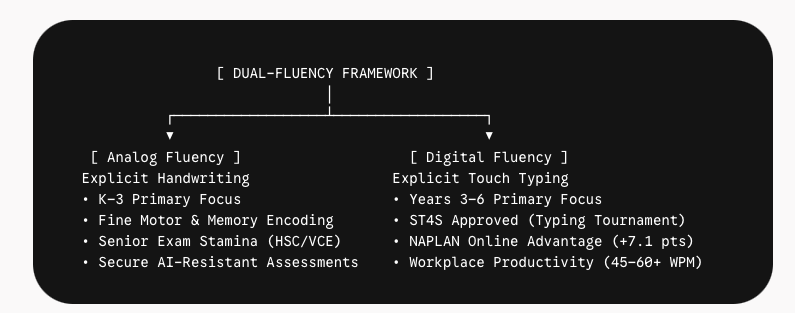
This logic underpins a modern Dual-Fluency Framework: handwriting builds the initial cognitive foundation, while explicit touch typing provides the motor tool for digital speed and productivity.
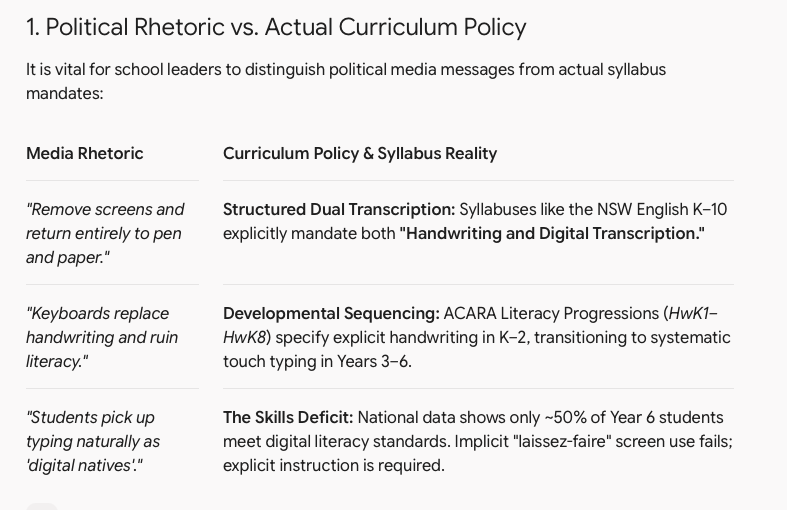
1. Political Rhetoric vs. Actual Curriculum Policy
It is vital for school leaders to distinguish political media messages from actual syllabus mandates:
| Media Rhetoric | Curriculum Policy & Syllabus Reality |
| “Remove screens and return entirely to pen and paper.” | Structured Dual Transcription: Syllabuses like the NSW English K–10 explicitly mandate both “Handwriting and Digital Transcription.” |
| “Keyboards replace handwriting and ruin literacy.” | Developmental Sequencing: ACARA Literacy Progressions (HwK1–HwK8) specify explicit handwriting in K–2, transitioning to systematic touch typing in Years 3–6. |
| “Students pick up typing naturally as ‘digital natives’.” | The Skills Deficit: National data shows only ~50% of Year 6 students meet digital literacy standards. Implicit “laissez-faire” screen use fails; explicit instruction is required.
Policy Realities Across Australia
State and national bodies are mandating explicit dual-transcription instruction:
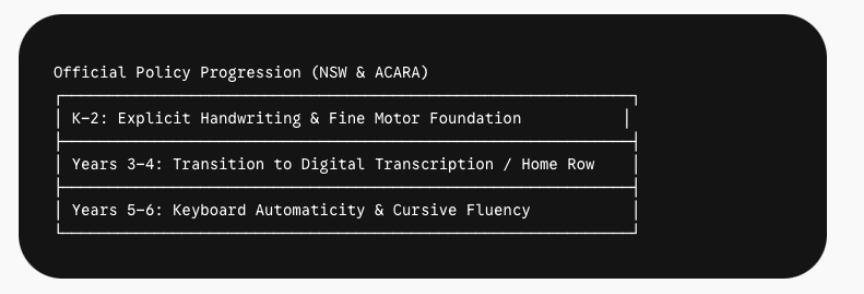
NSW Department of Education: The NSW English Syllabus explicitly broadens handwriting into “Handwriting and Digital Transcription.” Departmental guidance recommends at least three dedicated weekly sessions, moving from K–2 pencil control to Stage 2–3 (Years 3–6) home-row placement, finger reach, and rhythmic typing.
National Alignment (ACARA & AERO): This aligns with ACARA Literacy Learning Progressions, where early handwriting mastery leads directly into keyboarding automaticity by upper primary.
2. The Science of Automaticity and Cognitive Load
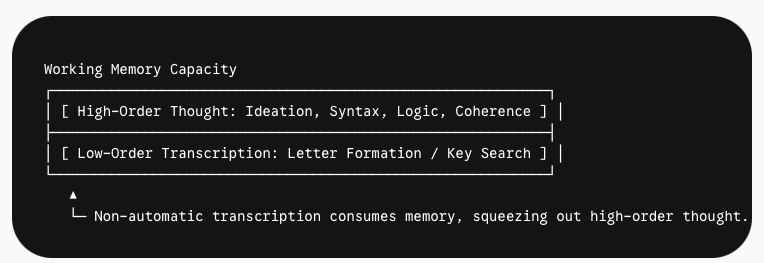
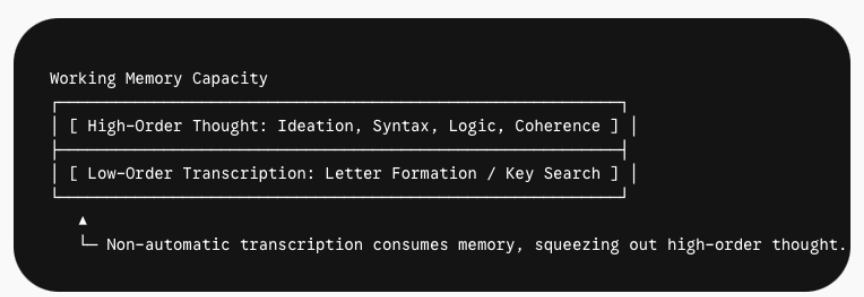
Under Cognitive Load Theory (Sweller), working memory has a strictly limited capacity. When composing text, the brain juggles two tasks:
Low-Level Transcription: Motor execution, letter formation, or key location.
High-Level Composition: Ideation, vocabulary choice, sentence structure, and logic.
When transcription is not automatic, it drains mental bandwidth away from higher-order thinking.
The Biological Engine of Handwriting
Neuroscientific EEG research (Van der Weel & Van der Meer) demonstrates that writing by hand engages complex motor pathways that foster neural connectivity, memory retention, and orthographic mapping. For young learners (K–3), handwriting is a non-negotiable cognitive foundation.
The Flaw of “Laissez-Faire” Keyboarding
When students transition to digital writing without explicit instruction, they default to “hunt-and-peck” typing. Hunt-and-peck is a visual-motor search task: every time a student looks at the keyboard, they interrupt their phonological loop and fragment their thought process. Hunt-and-peck typing caps out at low speeds (10 to 15 WPM), creating a permanent cognitive bottleneck where ideas fade before they can be transcribed.
3. The Evidence: Keyboarding Fluency and NAPLAN Success
While ACARA aims to make NAPLAN “keyboarding neutral,” empirical research demonstrates that typing fluency directly drives student academic output.
The Typing Tournament NAPLAN Research Study
A study analyzing 99 Australian schools (~5,350 Year 5 students across government, non-government, metro, regional, and remote sectors) evaluated the impact of touch-typing fluency on the Year 5 NAPLAN Online Writing Task:
+7.1 Mark Advantage: Schools where Year 5 students achieved functional touch-typing fluency (greater then 18 WPM) scored 7.1 marks higher on the NAPLAN Writing Task compared to their official ACARA “Similar Schools” benchmarks (p = 0.000002).
1.6 Terms of Progress: A 7.1-mark increase equals gaining over an entire school term of accelerated academic growth in writing across the NAPLAN years (Years 3–9).
Demographic Consistency: The benefit was remarkably uniform across all socio-economic groups, school sizes, sectors, and geographic locations.
Why Fluency Unlocks Achievement
Primary students write by hand at an average speed of 10 to 13 WPM. Achieving a touch-typing speed of 18 to 20 WPM meets or surpasses handwriting speed, eliminating transcription load. Touch typing becomes a subconscious habit handled by the basal ganglia, freeing 100% of working memory for sentence construction, editing, and reasoning. At speeds of 45 to 60 WPM, composition on screen becomes completely fluid and uninterrupted.
4. The Tool Imperative: Why Typing Tournament Leads Australian Schools
Teaching touch typing manually in a crowded curriculum is challenging. To save costs, some schools turn to free web apps funded by in-app advertising. However, unvetted software introduces severe privacy, safety, and instructional risks.
ST4S Assessed and Allowable Nationally
Unlike ad-supported platforms that track student data, Typing Tournament is Safer Technologies for Schools (ST4S) assessed.
National Compliance: It is fully approved and allowable for classroom use across all Australian State and Territory Departments of Education, Catholic dioceses, and Independent school sectors.
Ad-Free Privacy: It complies with strict national student data privacy and cybersecurity standards, ensuring 100% ad-free, secure learning environments.
Purpose-Built Pedagogy
Competitor tools often allow students to skip lessons or use incorrect finger placements. Typing Tournament enforces authentic muscle memory:
Active Finger Guidance: Actively trains the right fingers for the right keys, preventing hunt-and-peck habits.
16-Level Progression: Ensures key mastery before advancing.
Rapid Speed Gains: Just 30 minutes of weekly practice yields an average increase of 6 WPM per term (or 20+ WPM per year), enabling primary students to easily reach 45+ WPM by Year 6.
5. Assessment Integrity in the AI Era
The rapid rise of Generative AI has forced a return to analog assessment security: supervised handwritten exams, oral vivas, and in-class paper writing.
However, students who rely exclusively on devices without building physical handwriting stamina suffer severe cramping and fatigue during 2-to-3-hour senior secondary written exams (e.g., HSC or VCE). Conversely, students who leave school without touch-typing fluency enter tertiary study and the workforce severely disadvantaged.
The Solution: A Balanced Dual-Fluency Model
Schools should adopt a Dual-Fluency Model aligned with cognitive science and state curriculum guidelines:
Early Primary (K–3): Focus on explicit handwriting, tripod grip, and fine motor control to build foundational neural pathways.
Middle Primary (Years 3–6): Allocate ~30 minutes/week for explicit, ST4S-approved touch typing via Typing Tournament alongside regular paper work to reach automaticity (≥18 to 45 WPM).
Secondary & Beyond: Maintain handwriting fluency for secure paper exams while utilising automatic touch typing (45 to 60 WPM) for high-volume digital productivity.
Conclusion
Handwriting and touch typing are complementary pathways to human thought. Surrendering touch typing to political soundbites or ad-funded software disadvantages students in online assessments and modern workplaces. Equally, abandoning handwriting deprives young learners of essential cognitive mapping.
By embedding explicit instruction in both handwriting and touch typing using safe, compliant platforms like Typing Tournament, Australian educators can preserve assessment security, liberate working memory, and equip students for lifelong academic success.
Take action now
If your school already has a subscription to Typing Tournament, then ensure that the students are completing at least two 15-minute sessions per week and that you are supervising them and encouraging them to use all of their fingers on the right keys.
If your school does not yet have a subscription to Typing Tournament then sign up for a free trial of Typing Tournament and introduce just two 15-minute weekly sessions of structured, touch-typing tuition using Typing Tournament. In a single term, your students can gain 6 WPM in transcription speed—unlocking the cognitive bandwidth they need to write with clarity, confidence, and flair.
References & Further Reading
ACARA (2020/2026). NAPLAN Online FAQ & Literacy Learning Progressions (HwK1–HwK8)
Brash, L. (EdAlive Research). Touch Typing Fluency and NAPLAN Online Performance: An Analysis of 99 Australian Schools
NSW Department of Education (2022/2026). English K–10 Syllabus: Handwriting and Digital Transcription Scope & Sequence
Safer Technologies for Schools (ST4S). National Privacy & Security Assessment Framework
Sweller, J. Cognitive Load Theory and Educational Practice
Van der Weel, F. R., & Van der Meer, A. L. (2020/2024). The Importance of Cursive Writing and Motor Memory in Brain Development EEG Studies, NTNU.
How falling for the “zero-sum”, “osmosis”, and “all screens are equal” fallacies threatens student literacy—and how to plan for 2027. When policy pivots rapidly, stressed
Typing in the NSW English Syllabus: what teachers need to know Reviewed against the English K–10 Syllabus (2022), the NSW Department of Education instructional sequences,
The Imperative Toward Automaticity in for typing and handwriting A brief for Victorian primary teachers and English leaders on the curricular logic of typing instruction