The November 2026 Education Ministers’ communiqué on the digital detox
Part 1: The communiqué — digital detox provisions Source: Education Ministers Meeting Communiqué, released 5 November 2026 for the meeting held on 2 November 2026.

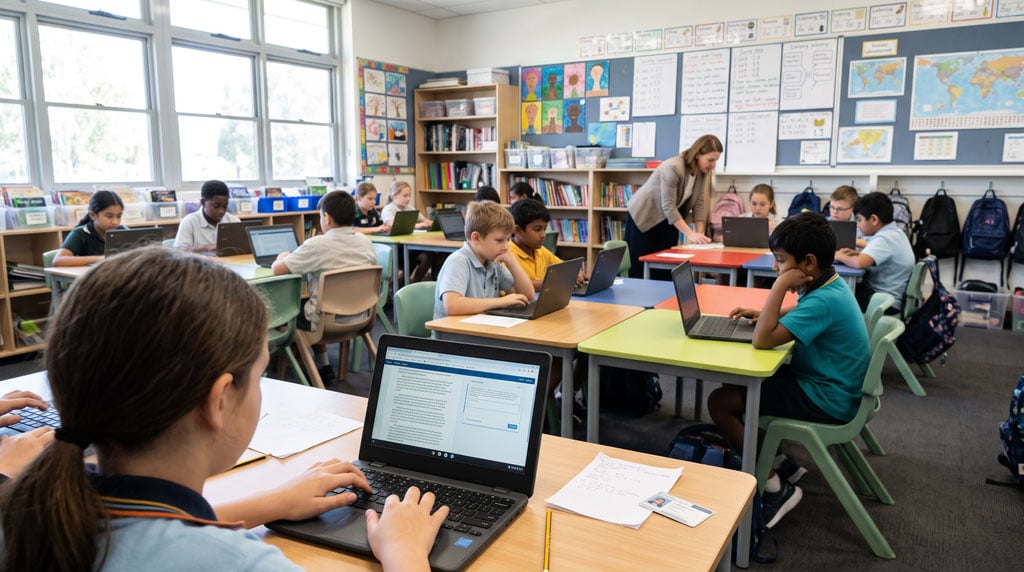
Australia’s debate about whether NAPLAN writing should be completed by hand or on a keyboard is part of a larger question: how do students learn to express what they know, and how should schools teach and assess that ability?
There is relevant research. It shows that keyboarding fluency is associated with the quality and productivity of computer-based writing, that assessment mode can affect students’ performance, and that controlled explicit typing programmes have produced improvements in writing, although benefits vary across measures. It does not settle whether teaching students to type fluently reduces mode differences in NAPLAN, which students benefit most from each mode, or how digital-learning policies affect the development of writing skills.
This article distinguishes what is known from what remains uncertain. It examines research published by ACARA, the NSW Centre for Education Statistics and Evaluation (CESE), and independent researchers; identifies the limits of that evidence; and suggests both immediate actions for schools and a research programme for policymakers.
A study of 544 Year 2 students in 47 Western Australian classrooms found that handwriting and keyboarding automaticity were associated with different aspects of composition. Handwriting automaticity was related to paper-based composition; keyboarding automaticity was related to the quality and productivity of computer-based composition, alongside spelling, reading and other factors (Malpique et al., 2025a). Keyboarding automaticity was measured using a timed alphabet-production task rather than a conventional copy-typing words-per-minute test.
This is evidence of a relationship—not proof that typing faster by itself causes better writing.
A study of 300 primary students found that handwriting was generally faster than keyboarding. The authors argued for explicit keyboarding instruction but did not test whether instruction would remove the difference between modes (Connelly, Gee, & Walsh, 2007). The study also found that keyboarding speed was related to the quality of keyboarded composition, adding to the evidence that transcription fluency matters for computer-based writing.
A meta-analysis covering 22 studies and 6,168 participants across several reading and writing outcomes found an average writing-quality advantage for handwritten passages in the subset of studies assessing that outcome (Malpique et al., 2024). That result does not establish that handwriting is inherently superior for every student or task. A study of Norwegian first-year students, by contrast, found no clear difference in narrative quality between handwriting and touchscreen keyboarding (Spilling et al., 2022).
The research does not yield one universal answer to “which mode is better?” Outcomes can depend on students’ skills, age, task, device and instruction.
It would be inaccurate to say ACARA conducted no research into online assessment. Its published work includes a 2012 pilot concerning the use of keyboards in writing assessment and later research on device effects.
ACARA’s summary report describes the 2012 pilot as investigating whether using a keyboard to complete a writing assessment affected the assessment (ACARA, 2014a). A separate ACARA paper reports that markers considered the pilot’s typed essays comparable in length and quality to typical handwritten responses (ACARA, 2015).
A separate 2014 cognitive-interview study concerning online spelling reported that no interviewed students felt penalised by typing (ACARA, 2014b); that finding relates to spelling, not the 2012 writing pilot.
These are relevant findings. But student interviews from a spelling study are not the same as an analysis of whether measured typing speed affected writing scores. Nor does a pilot comparing assessment properties answer whether students who type slowly produce different writing under timed conditions.
The precise point, therefore, is not that ACARA did no research; it is that the published material reviewed for this article does not provide an analysis linking individual students’ measured typing speed to their writing marks in operational NAPLAN.
The NSW CESE study compared paper and computer writing completed by the same students in a 2016 research trial. Its paired design is valuable because it compares modes within students rather than relying only on separate groups (Centre for Education Statistics and Evaluation, 2021).
Across the trial, 1,651 students had paired paper and computer writing scores, and 1,323 had typing-test results; 879 students had both writing and typing data. The statistical model examining typing and the mode difference used 840 students with the necessary additional literacy data. CESE estimated that computer-based writing scores were, on average, 15 to 20 NAPLAN scaled points lower than paper-based scores, depending on year level. In CESE’s model, a typing speed five words per minute higher was associated with an approximately 7.5-point smaller paper–computer gap. This association does not establish that teaching an individual student to type five words per minute faster would cause an equivalent score change.
CESE is a government research report, not a peer-reviewed journal article. It nevertheless provides an important Australian baseline and a paired comparison of the same students.
The report’s findings should be interpreted within its scope. Most participating schools did not explicitly teach keyboarding. CESE did not test a group systematically taught to a defined level of typing proficiency. It therefore cannot establish whether explicit instruction would reduce or remove the computer–paper difference.
It would also be inaccurate to say that no research has tested typing instruction and writing outcomes.
Christensen (2004) compared 35 Grade 8 and 9 students selected for very low initial typing proficiency. One group received a typing-skills programme and the other wrote daily journals on a word processor. Both groups improved, but the typing-instruction group achieved significantly better post-test typing results and better quality in typewritten composition. The benefit was specific to typewritten composition; the study did not find a corresponding difference in handwritten composition.
Gahshan-Haddad and Weintraub (2025) studied a combined typing and word-processing programme with Grade 4 students. The programme group made greater gains in typing, word processing, composition quantity, and composition structure. The between-group result for total composition quality was not statistically significant in the detailed analysis. The study involved only two schools—one per condition—and combined several instructional components, so the contribution of typing instruction alone cannot be isolated.
Van Weerdenburg, Tesselhof and Van der Meijden (2019) studied 207 students in Grades 4–6 (154 in a parent-selected, fee-paying course and 53 controls) who took an intensive seven-month touch-typing course with teacher supervision and home practice. The course group made greater gains in typing and computer-based narrative writing; the spelling gain was significant in Grades 4 and 6 but not Grade 5. Because the programme included language-related activities, the study supports the combined programme but cannot isolate the effect of typing speed alone.
Donica and colleagues (2018) compared a structured keyboarding programme with free web-based activities across four schools. The study measured keyboarding, not writing quality, and its findings varied by grade and outcome.
Beers and colleagues (2017) compared handwritten and keyboarded compositions by 54 students in Grades 4–9 with and without dysgraphia or dyslexia. Keyboarding produced faster active writing rates and longer texts, though interspersed with more frequent pauses and shorter bursts of continuous text. The study found no significant interaction between diagnosis and mode.
Not every controlled study has found writing benefits. Gail J. Gerlach (1987) randomly assigned 19 Grade 4 students to a typing tutorial or no keyboarding instruction. The study found no significant between-group differences in composition length, revisions or attitudes. The tutorial group showed significant gains in typing speed and accuracy after four months of supervised word-processing use. “Because the sample was so small, the absence of significant differences in length or revisions cannot be taken as proof that instruction had no effect—and the available record does not report an overall writing-quality score.”
Taken together, several controlled studies report improvements in typing and in aspects of computer-based composition, although not every programme or measured outcome has shown an advantage (e.g., Daniels, 2020). They support further investigation of explicit instruction, but do not establish that every programme works equally well, or that teaching typing will eliminate every assessment-mode difference.
The evidence is best understood by distinguishing the questions each study was designed to answer.
ACARA’s published work considered matters such as:
That work is relevant to the transition from paper to online testing. However, the published material reviewed for this article does not report an analysis of individual students’ words-per-minute typing speeds against their operational NAPLAN writing marks.
The distinction matters. Research that asks whether students feel comfortable typing does not directly answer whether typing fluency affects their writing scores. Research on device suitability does not necessarily answer whether students who type slowly produce different writing under timed conditions.
CESE examined how the same students performed on paper and on computer, and how typing speed related to the difference. It is a departmental report rather than a peer-reviewed journal article. Its paired design is a strength, but it describes students under the teaching conditions that existed in the participating schools.
It did not test whether a group taught to a defined standard of keyboard fluency would show the same mode difference. It therefore cannot tell policymakers what computer-based writing assessment could achieve after effective keyboarding instruction.
The EdAlive/Brash analysis examined Year 5 NAPLAN writing results from 99 schools against each school’s Similar Schools benchmark. It is developer-funded, not peer-reviewed and cohort-level rather than student-level. The report also states that the sample was not a random representation of Australian schools (Brash, 2020).
Its findings should be treated as evidence of association, not proof that typing instruction caused higher scores. Within that already-selected group of schools, higher typing speed, accuracy or activity volume was not associated with an additional writing-score advantage. The study is nevertheless relevant because it analyses live NAPLAN writing results alongside keyboarding data—an analysis that could not be foundin the ACARA research reviewed for this article.
Read together, the studies contribute different pieces:
No single study answers all the policy questions. Taken together, they support further research and careful teaching—not a confident claim that one mode is always superior.
Australian curriculum documents describe keyboarding through abstract terms such as “automaticity”, “fluency” and “efficiency”, but generally do not specify the speed, accuracy, teaching time or assessment method expected.
It is plausible that such open-ended wording affects how teachers interpret their responsibility. A teacher may understand “automaticity” as a general aspiration rather than a requirement for a planned sequence of keyboarding lessons. If so, vague language could contribute to a belief that students will acquire typing through exposure, or that any use of a device satisfies the curriculum.
That causal connection has not been established by the research cited here. Malpique and colleagues’ survey (2025b) documents teachers’ reported preparation, confidence and keyboarding practices, but does not show that curriculum wording caused those practices. Nor does it test whether adding numerical standards changes instruction or student outcomes.
This should be investigated rather than assumed. Researchers could compare curriculum wording across jurisdictions, survey teachers’ interpretations, and examine whether clearer expectations are associated with differences in lesson time, supervision, teacher confidence and student skill. A well-designed study should distinguish curriculum wording from other influences, including teacher training, school resources, leadership and assessment incentives.
Until that evidence exists, it is reasonable to say that vague curriculum language may make keyboarding easier to leave untaught. It would be premature to claim that abstract descriptors alone caused the problem—or that replacing them with numbers will solve it. The relationship itself belongs on the research agenda.
On 2 November 2026, education ministers agreed that Year 5 NAPLAN writing would return to handwritten completion in 2028, subject to further ACARA advice on feasibility, costs and workload (Education Ministers Meeting, 2026). Ministers also requested advice on handwritten writing assessments for Years 7 and 9.
The decision forms part of a wider discussion about screen time, generative AI and digital learning. Concerns about excessive or poorly structured device use are legitimate. So are concerns about distraction and the developmental value of handwriting.
While policy decisions of this kind often seek to signal broader systemic priorities for primary literacy and classroom focus, general evidence about screen use does not, by itself, answer the specific question: what assessment mode best measures students’ writing, given their transcription skills?
ACARA has published research on online test design and device effects. Its 2012 pilot examined whether using a keyboard to complete a writing assessment affected test properties, and later device-effect research considered whether different devices affected student performance (ACARA, 2014a; ACARA, n.d.).
These studies matter. They mean it would be inaccurate to say ACARA did no research into online assessment. But the published material reviewed for this article does not provide a transcription-specific analysis of typing speed and operational NAPLAN writing outcomes.
The one departmental study that examined transcription in detail, CESE, recommended developing and monitoring typing fluency, not abandoning the online mode. The 2020 NAPLAN Review also recommended explicit keyboarding instruction and monitoring beyond Year 3 (McGaw, Louden, & Wyatt-Smith, 2020).
The policy questions that remain include:
A change in assessment mode may ultimately be defensible. But the evidence should match the decision. If the aim is to measure writing composition, policymakers need to understand how each mode affects what students can demonstrate.
A single-mode assessment may disadvantage students whose transcription skills do not match that mode.
A handwritten test can constrain students with dysgraphia, developmental coordination disorder, fine-motor difficulties, or slow and painful handwriting. A keyboarded test can constrain students who type slowly, have little access to keyboards or have never received explicit instruction.
Research involving students with dysgraphia and related conditions shows why assumptions are unsafe. In Beers et al. (2017), keyboarding was associated with faster active writing rates and longer texts, but also with more frequent pauses. In Khoury-Shaheen and Weintraub (2026), students with developmental coordination disorder had less legible handwriting and slower keyboarding than their peers, but the study found no statistically significant difference in keyboarding accuracy. None of the students had learned formal touch typing, and both groups generally handwrote faster than they typed.
These findings suggest two principles:
Students should not have to meet a typing target before receiving a reasonable adjustment. Depending on the student’s needs, an adjustment may include a keyboard, adapted input device, speech-to-text software, extra time, or an alternative assessment format.
Assessment policy should consider individual handwriting and keyboarding profiles rather than assume that a diagnosis, a device or a test mode predicts what a student can do.
The following questions merit study. Related topics have been investigated, but the specific questions below remain unanswered or only partly answered.
| Research question | What existing evidence does not yet tell us |
| Does explicit keyboarding instruction reduce the computer–paper writing difference? | CESE compared modes but did not test a cohort taught to a defined proficiency. Intervention studies report positive but uneven results across measures. |
| What measures indicate automaticity during composition? | Speed alone cannot distinguish fluent execution from visually dependent hunting-and-pecking, or copy performance from composing. |
| Is there a useful fluency threshold, and does it vary by age or task? | Research links transcription skills to writing but has not established a universal threshold at which typing no longer constrains composition. |
| Does curriculum wording influence teachers’ keyboarding instruction? | Teacher surveys document reported preparation and practice, but do not establish whether vague descriptors affect lesson time, beliefs or student outcomes. |
| What speed and accuracy goals are appropriate for each year level, and how should they be established and tested? | I have not found an Australian study establishing age-referenced copy-typing targets with defined accuracy gates. CESE reports a Year 5 median speed of 15.4 wpm and a separate median accuracy of 94.9%, and a Year 4 median of 10.3 wpm. The EdAlive analysis used 18 wpm as a class-selection criterion, not as a validated threshold. Overseas standards differ in purpose and status and do not establish a common developmental staircase. |
| Which students benefit from or are disadvantaged by each mode? | Studies examine some groups, but broader Australian evidence is needed across handwriting and typing profiles, disability, access and task type. |
| How should scores be equated when pupils use different modes? | A paper–computer score difference has been observed, but a robust common-scale method for mixed-mode assessment requires further testing. |
| How do screen-time policies affect digital-skills teaching? | Digital-detox policies are new. Their effects on keyboard access, instruction time and digital learning require prospective evaluation. |
| What are the longer-term effects on confidence, writing avoidance and participation? | These effects are often asserted or described anecdotally. Their prevalence and relationship to transcription fluency need direct study. |
| How does keyboard fluency affect pupils’ use of AI? | Whether keyboard and composition fluency helps pupils verify, edit and direct AI-generated text remains largely unstudied. |
Research takes time. Schools still need to teach students in the meantime.
The evidence already supports several practical steps:
These steps do not require schools to decide that keyboards are always better than pens. They require schools to teach both and recognise that a student’s ability to compose may depend on the mode used.
Schools do not need to wait for final research to set expectations. The goals below are provisional working targets for teaching, formative assessment and evaluation. They are author-proposed figures for piloting—not validated standards or curriculum requirements, and they should not be used as high-stakes pass-or-fail measures.
They draw on three sources: CESE’s Australian baseline (median Year 5 speed of 15.4 wpm and a separate median accuracy of 94.9%); the EdAlive class-selection criterion of 18 wpm; and overseas standards, which vary in purpose and status, scaled upward linearly toward secondary word-processing norms.
Note: This table of speed and accuracy goals is provisional and will be updated early in 2027 based on an analysis of age and speed data from Typing Tournament.
| End of year | Provisional copy-typing target | Accuracy target | Observable performance to look for alongside the number |
| Foundation–Year 1 | No speed target | Not applicable | Correct posture; letter and basic key location; short, guided activities without speed pressure |
| Year 2 | Aspirational: 8–10 wpm | 90% | Foundational hand-eye coordination; increasing familiarity with key locations; brief copy tasks |
| Year 3 | Aspirational: 12–15 wpm | 92–95% | Alphabet keys increasingly recognised by location; simple punctuation |
| Year 4 | Working target: 15–18 wpm, moving towards 18–20 wpm | 95% | Three-minute copy task; eyes mainly on copy or screen; able to compose and revise a short passage without continual key searching |
| Year 5 | Working target: 18–22 wpm | 95% | Sustains a three-minute task; corrects text; begins using common shortcuts |
| Year 6 | Working target: 22–28 wpm | 95–97% | Independent drafting and editing; basic tables and document management |
| Years 7–8 | Working target: 30–35 wpm | 97% | Applies typing across subjects; produces reports, citations and spreadsheet entries |
| Year 10 | Working target: 40–45 wpm | 97% | Composes, formats and revises documents under normal assessment conditions |
The evidence base is not empty, but it is not settled.
The research indicates that transcription skills relate to writing, that assessment mode can affect performance, and that explicit typing programmes have produced positive but uneven results. It has not established a universal automaticity threshold, nor shown whether well-taught keyboarded assessment is fairer than handwritten assessment for every student.
The most important missing evidence is specific: what happens when Australian students are explicitly taught both modes, measured in both, and assessed on comparable writing tasks. In my judgement, that is the research Australia needs before making major decisions about NAPLAN mode and digital learning. Meanwhile, schools should continue to teach handwriting, teach keyboarding, provide appropriate access and use digital tools purposefully.
State the claim. Publish the evidence. Make the data available. Let policy change when the evidence changes.
Typing Tournament is an Australian-developed, mastery-learning touch-typing program designed specifically for primary and secondary classrooms. Fully aligned with national and state curriculum outcomes and literacy objectives across every Australian jurisdiction, it is grounded in Cognitive Load Theory—using explicit, step-by-step scaffolding and brief 10-to-15-minute practice sessions to build genuine motor automaticity without overwhelming working memory or exceeding daily screen-time limits.
Experience it in your classrooms: Australian schools are invited to take a free, no-obligation 1-month school trial of Typing Tournament to see how easily systematic keyboarding fits within a balanced, Dual Fluency timetable.
Author’s Note: I used AI alongside my own knowledge of the issues and teaching practice to create this comprehensive resource. Declaring the use of AI is a matter of transparency and does not detract from the value of the synthesis presented here. If you spot any errors of fact or wish to challenge any of the conclusions drawn, I welcome your feedback—please send it to info@edalive.com marked to my attention.