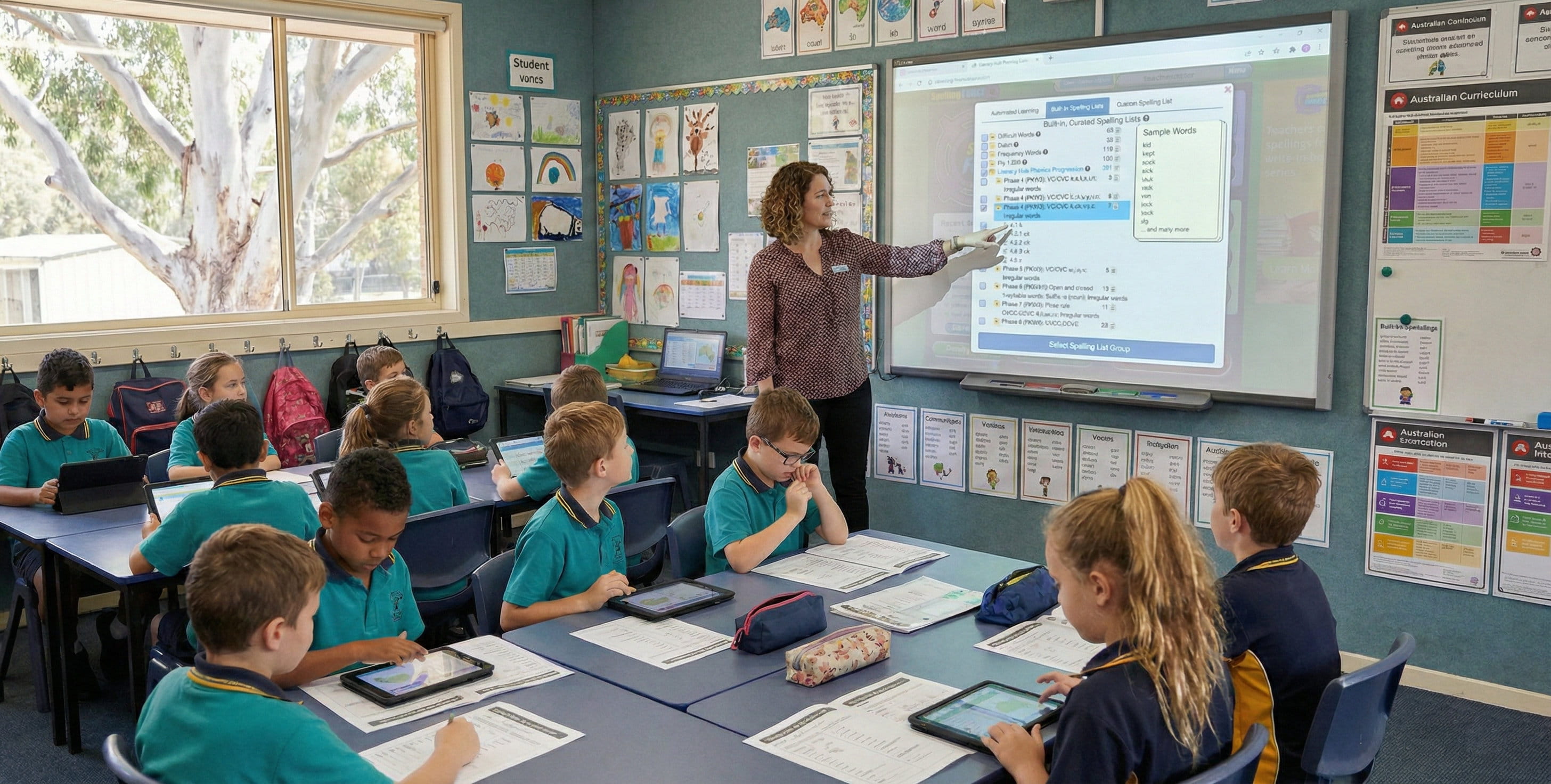
EdAlive’s Spelling Force Literacy Hub Spelling Lists progression fully encompasses and builds on the Literacy Hub progression. The Spelling Force Literacy Hub Spelling Lists comprise a bank of over 4,200 carefully sequenced words in [number] lists, mirroring the Literacy Bank Phases 1–24 (K- Year 3) and associated Phonics and Morphology Lesson Packs. These lists closely follow the Literacy Hub’s guidelines, offering teachers a ready-made resource that aligns with contemporary best practice.
The result is that the Spelling Force Literacy Hub Spelling Lists form an extremely comprehensive resource that accords precisely with the Literacy Hub progression and includes revision lists and supplementary frequency words. By aligning classroom practice with the Literacy Hub’s core principles and leveraging the extensive, phase-based word lists through the Spelling Force Literacy Hub Spelling Lists, schools can offer students a spelling programme that is explicit, systematic, engaging, and demonstrably effective from Foundation through Year 3.
Design of the Spelling Force Literacy Hub Spelling Lists
The Spelling Force Literacy Hub Spelling Lists include all the words used in the Literacy Hub example words and the Literacy Hub Phonics and Morphology Lesson Packs 1 – 24 with additional words drawn from the built-in Spelling Force vocabulary.
At the end of each year level, we have included additional Spelling Force Literacy Hub Spelling Lists to revise the irregular words introduced throughout the year level.
Additionally, we have added important high frequency words at the end of each year level, which are not covered elsewhere by the Literacy Hub material.
Within each weekly lesson structure, the Spelling Force word lists include the key examples used in Literacy Hub materials followed by many additional words using the same pattern.
We recommend students work through the weekly Spelling Force Literacy Hub Spelling Lists in the order presented and proceed at their own pace.
Such is the scope of the additional materials provided in the Spelling Force Literacy Hub Spelling Lists that students may not need to complete all work to demonstrate mastery of a concept; however, for students needing repetition or extension, ample examples are provided.
Use solo or in combination with Phonics and Morphology Lesson packs
The Spelling Force Literacy Hub Spelling Lists can be used solely within Spelling Force or in conjunction with the Literacy Hub materials.
Track student progress using the Spelling Force Spelling Lists report function by itself or use in conjunction with the Literacy Hub Progress Monitoring Tool Tracker.
Use the Spelling Force Literacy Hub Spelling Lists in conjunction with the Literacy Hub Phonics and Morphology Lesson packs to deliver a complete seamlessly integrated spelling programme with printed resources, PowerPoint slides, practice, reinforcement, assessment and reporting.
Practical, time saving and classroom-ready
A key strength of the Literacy Hub is its emphasis on practical routines: short, daily lessons; explicit modelling; guided practice; and independent application. However, designing coherent word lists to match this pedagogy can be time-consuming for busy teachers. Here the 4,200 word Spelling Force Literacy Hub Spelling Lists resource offers a significant advantage in that it:
Provides ready-to-use lists structured by pattern, complexity, and phase.
Reduces planning load while maintaining alignment with evidence-based practice.
Offers digital practice that reinforces in-class teaching through engaging repetition and feedback.
The combination of sound pedagogy and purpose-built technology gives teachers a ready-to-use, coherent, defensible approach to spelling encompassing explicit teaching in class, cumulative and structured Spelling Force Literacy Hub Spelling Lists, and rich opportunities for practice and application.
Print student worksheets using the Spelling Force worksheet function.
About the Literacy Hub
The Literacy Hub is published by the Commonwealth of Australia through the Australian Government’s Department of Education. It provides a central, publicly accessible collection of evidence-informed guidance, resources and practical teaching materials to support literacy instruction across Australian schools.
The Literacy Hub materials provide a clear, research-aligned framework for teaching spelling across the primary years. Its approach positions spelling not as rote memorisation, but as a teachable system that links sounds, letter patterns, word structure, and meaning.
Structure of the Literacy Hub spelling progression
The Literacy Hub phonics progression includes a sequence of letter–sound correspondences and phonics skills for use from Foundation to Year 3 though 24 Phases broken down into weekly lessons and mapped to the Australian Curriculum outcomes PKW3 to PKW8. Learn more
Each Phase is supported by a wide range of classroom teaching materials including worksheets and PowerPoint slides. Learn More
The phases of the progression are mapped to the Australian Curriculum V9 in English as follows:
Phase 1–5: Foundation
Phases 6–12: Year 1
Phases 13–17: Year 2
Phases 18–24: Year 3
The integration of Literacy Hub with Spelling Force.
At the heart of the Literacy Hub’s guidance and the design of the Spelling Force Literacy Hub Spelling Lists are a set of core principles that transform the teaching of spelling.
1. Explicit and systematic instruction.
The Literacy Hub emphasises that effective spelling instruction is “explicit”: teachers directly teach sound–letter relationships, patterns, and word structures rather than expecting students to infer them incidentally.
This instruction is also “systematic”: concepts are introduced in a planned, sequential order, moving from simple to complex and continually revisiting previously taught content. EdAlive’s 24-phase sequence used in the Spelling Force Literacy Hub Spelling Lists reflects this logic, beginning with simple CVC words and building towards more complex vowel patterns and morphemes by Year 3.
2. A multi-component focus
Spelling is framed as an integration of multiple, interacting systems:
Phonology – how words sound and how to segment, blend, and manipulate phonemes.
Orthography – how sounds map to letters and patterns (e.g. digraphs, long vowel spellings).
Morphology – how word parts carry meaning (e.g. jump, jumped, jumping), and how prefixes and suffixes affect spelling and meaning.
Vocabulary and meaning – using word meaning and families to support memory and generalisation.
Word lists that follow this framework, such as the Spelling Force Literacy Hub Spelling Lists, are not random compilations. They group words by pattern and/or morpheme so that students see and practise the underlying structure of English spelling.
3. Cumulative learning and transfer to reading and writing
The Literacy Hub highlights the need for cumulative review: new learning is always built on and integrated with prior knowledge. Spelling patterns taught in earlier phases are woven into later instruction so that knowledge becomes stable and automatic. The Spelling Force Literacy Hub Spelling Lists follow this same approach.
4. Assessment-informed and differentiated
Formative assessment – through quick spelling probes, dictation, and writing samples – is central to the Literacy Hub’s approach. Teachers use this information to:
Identify which patterns and morphemes each student has mastered.
Group students flexibly according to need.
Provide extra practice or targeted intervention where gaps appear.
The structured resource of the 4,200-word Spelling Force Literacy Hub Spelling Lists progression supports this principle by allowing teachers to pinpoint concepts where students are secure and where further teaching is needed, and then assign phase-appropriate practice within Spelling Force Online.
5. Evidence-based and comprehensive
The Literacy Hub draws on a strong evidence base that recognises spelling as a code that can be systematically taught. It integrates phonics, orthographic patterns, and morphology, moving beyond “spelling lists for Friday tests” towards deep, transferable knowledge.
EdAlive’s Spelling Force Literacy Hub Spelling Lists, organised into 24 developmental phases and covering approximately Foundation to Year 3, mirror this comprehensive approach. The sequence allows teachers to track and support the growth of students’ orthographic knowledge across the early years.
Key needs the Literacy Hub was designed to address
The Literacy Hub was published to make high‑quality, research-aligned literacy practice widely available to Australian educators, helping schools deliver systematic, explicit instruction and thereby improve student literacy outcomes. It is designed to:
Provide accessible, evidence-based guidance for teachers: translate research on phonics, phonological awareness, orthography and morphology into classroom-ready practice.
Reduce variability in practice: offer a consistent national reference so schools and teachers across jurisdictions have a common framework for high-quality spelling, reading and writing instruction.
Improve early literacy outcomes: support systematic teaching from Foundation/Kindergarten through early primary years to build durable reading and spelling skills and improve performance on national monitoring tools (e.g., NAPLAN).
Support teacher capability and professional learning: give practical routines, scope-and-sequence advice, and diagnostic approaches so teachers can plan effective lessons and target intervention.
Strengthen assessment and targeted intervention: emphasise formative diagnostics and flexible grouping to identify gaps and deliver timely support for students with difficulties.
As students progress beyond the foundational basics, the requirements for effective spelling instruction shift from simple sound–letter matching to a more complex understanding of word
The journey through the September 2025 Literacy Hub Phonics Progression begins with the critical transition from the Foundation Year into Year 1. During the Foundation