EdAlive’s six online learning titles—Spelling Force, Typing Tournament, Maths Invaders, Words Rock, Baggin’ the Dragon Maths, and Volcanic Panic Synthetic Phonics move beyond the “massing” of content (drilling concepts in a single session) to a scientifically grounded model of spacing, explicit teaching, and personalised adaptive learning. Founded on a deconstruction of major global curricula (UK, USA, Australia, and Singapore), the platform’s six core titles—Spelling Force, Typing Tournament, Maths Invaders, Words Rock, Baggin’ the Dragon Maths, and Volcanic Panic Synthetic Phonics—are rigorously engineered environments with vast content used to create granular learning progressions and for mapping a wide variety of additional syllabi and curricula against.
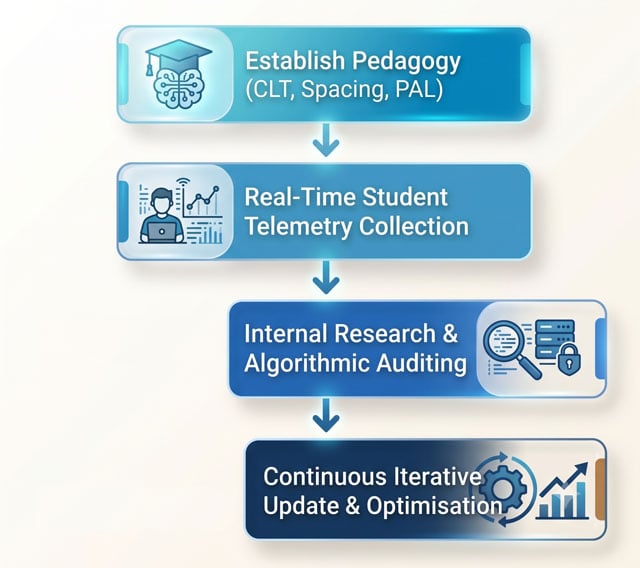
EdAlive uses an Evidence-Based Iterative Design Cycle and does not merely inherit educational theories; it actively conducts ongoing internal research using mass student telemetry to validate these models, continuously optimising the algorithm-driven student experience.
While the software provides automated, self-adjusting paths for independent learning, it features a dual-control architecture. This provides teachers with precise control to manually override paths, assign targeted curriculum content, and access deep-dive diagnostic reporting.
The following analysis indicates how EdAlive integrates Cognitive Load Theory (CLT), Spacing and Massing dynamics, and Explicit Teaching, demonstrating how each title applies these models in practice and how continuous optimisation refines student learning.
I. The Core Pedagogical Framework
EdAlive’s design philosophy is anchored in four pillars of educational psychology, refined by empirical validation:
1. Cognitive Load Theory (CLT) & The Management of Complexity
CLT posits that working memory has a limited capacity for processing new information. EdAlive mitigates extraneous load (distractions) by using high-fidelity, intuitive game interfaces that focus attention on the learning task. Simultaneously, it optimises germane load (effort devoted to schema construction) by breaking complex curricula into “micro-challenges.” This ensures that the learner is never overwhelmed, allowing them to progress from novice to expert without cognitive burnout.
2. Spacing vs. Massing: The Architecture of Retention
Educational literature confirms that learning is significantly more efficient when concepts are revisited over multiple sessions (spacing) rather than “hammered” in one session (massing).
The Problem: Most online educational systems rely on massing, leading to rapid decay of knowledge once the student exits the app.
The EdAlive Solution: By embedding learning in an individualised instruction framework, the system naturally spaces repetition out over time. Returning to previously mastered concepts at varying intervals strengthens long-term memory retrieval pathways.
3. Explicit Teaching & Intentional Sequencing
EdAlive does not rely on passive, discovery-based learning. Every activity is mapped to specific learning outcomes in major curricula. The platform utilises Explicit Teaching methods: clear modelling of skills, guided practice, and immediate corrective feedback. Teaching progressions are “intentionally sequenced,” ensuring that foundational skills (e.g., phoneme-grapheme correspondences) are completely mastered before advancing to complex applications (e.g., reading comprehension).
4. Individualised Instruction, Adaptive Learning, & The Iterative Validation Cycle
Recognising that “every student’s learning needs are different,” EdAlive employs Personalised Adaptive Learning (PAL) systems that dynamically adjust difficulty in real-time.
The Continuous Optimisation Loop: EdAlive validates its algorithmic effectiveness by auditing student metadata (such as error rates, “Too Hard” feedback triggers, and transition sequences). For example, finding that initial errors resolve into correct spellings over subsequent attempts lets EdAlive continuously refine its adaptive calibration models to optimise the student experience.
Dual-Control Utility (Teacher Agency vs. Algorithmic Automation): While adaptive automation manages the standard instructional path, teachers retain total agency over the platform. The system features deep administrative overrides, allowing educators to assign specific units, align tasks with physical classroom lesson plans, freeze students at specific levels, or generate extensive diagnostic reports.
II. Operational Analysis: The Six Titles
The following section details how each title applies the framework above to specific domains of literacy and numeracy.
Pedagogical Focus: Orthographic mapping and spelling mastery.
Application of Theory:
Mastery Learning:Spelling Force utilises a rigorous “Mastery Set” empirical model. A word set is only declared “mastered” when the student achieves an optimal success rate (87% correct in standard mastered sets) over spaced attempts.
Continuous Optimisation in Action: Long-term internal telemetry analysis of word sets enables EdAlive to optimise its adaptive “re-levelling” engine.
Explicit Recovery Progression: Research on sequential word paths showed that after an initial spelling error, students achieved a success rate of 75% on their second attempt, 62% on their third, and 55% on their fourth. This demonstrates a cumulative recovery rate of 88% over four attempts, proving that the software encourages active retrieval practice and self-correction rather than mindless guessing.
Pedagogical Focus: Keyboarding accuracy, speed, and muscle memory.
Application of Theory:
Explicit Teaching: The curriculum is deconstructed into specific keyboard row progressions, ensuring students learn correct finger-to-key mapping systematically.
Extensive Teacher Control: In addition to the automated pace-maker, teachers can enforce strict words-per-minute (WPM) goals, restrict access to advanced games until home-row keys are mastered, and customise typing materials to align with classroom writing prompts.
Continuous Optimisation: Telemetry tracking of keystroke intervals has been used to refine the visual guide overlay, minimising extraneous cognitive load by highlighting correct key pathways only at the exact millisecond of pause.
3. Maths Invaders: Fact Fluency via Spaced Retrieval
Pedagogical Focus: Arithmetic fact fluency (addition, subtraction, multiplication, and division).
Application of Theory:
Spacing Over Massing: Traditional flashcard methods rely on massing. Maths Invaders embeds mental math into a gamified spaced retrieval framework. Internal studies demonstrate this raises fact recall speed by 2 times and increases overall math competency by 6 to12 months.
Reporting and Agency: The program features extensive diagnostic reports that isolate exact mathematical weaknesses (e.g., specific times table gaps like 7 times 8). Teachers can intervene, bypass the adaptive engine, and assign targeted practice modules to address those individual concepts.
4. Words Rock: Lexical Expansion & Modular Content Selection
Pedagogical Focus: Spelling, grammar, punctuation, and vocabulary.
Application of Theory:
Explicit Syntax Instruction:Words Rock maps tasks of varying abstract complexities directly to core curricular syntax outcomes.
Granular Instructional Control: Rather than relying solely on the PAL engine, teachers can use the Tools and Reports content selector to hand-select grammar objectives—such as isolating search scopes exclusively to subjective pronouns or coordinating conjunctions—for targeted remedial instruction.
Mitigating Cognitive Load: Complex grammar lessons are rendered as puzzle components, turning dry, text-heavy instructions into manageable visual tasks.
5. Baggin’ the Dragon Maths: Multi-Branch Numeracy & Adaptive Scaling
Curriculum Coverage: Covers over 10,000 questions mapped to major curricula.
Adaptive Scaling: The title employs adaptive scaling algorithms. Correct responses scale the student up to higher difficulty curves (e.g., transitioning from simple ratios to algebraic fractions), while incorrect trends systematically scale the questions down to more pictorial, concrete representations.
Progress Overviews: Comprehensive reporting features keep teachers informed, showing color-coded matrices of class progress across every mathematical branch, simplifying student assessment.
Explicit Synthetic Phonics: The software is built around a systematic synthetic phonics sequence, starting with simple grapheme-phoneme correspondences before moving to split-digraphs and multi-syllabic blending.
Progress Overviews: Comprehensive reporting features keep teachers informed, showing color-coded matrices of class progress across every mathematical branch, simplifying student assessment.
III. System Integration & Administrative Control
To ensure that the digital experience aligns with actual classroom instruction, EdAlive provides robust diagnostic and administrative tools:
1. Extensive Teacher Control Capabilities
EdAlive features a comprehensive central dashboard designed for modern classrooms:
The Content Assignment Matrix: In all of the 6 titles teachers can override the automated adaptive path.
Targeted Classroom Alignment: Teachers can search for modules by specific curriculum codes (such as Common Core, National Curriculum, or Australian Curriculum) to ensure the online activities match their offline lesson plans.
Direct Task Deployment: Teachers can quickly create homework challenges or test events for individual students, self-selected focus groups, or the entire class.
2. View Deep-Dive Diagnostic & Progress Reporting
The reporting suite translates raw student data into actionable insights:
Predictive Achievement Logs: Reports go beyond simple “grades” to identify trends, predicting if a student is on track to meet Year/Grade standards.
Error Analysis Mapping: The platform tracks and categorises specific errors, helping teachers identify exactly what a student is struggling with (e.g., distinguishing between a spelling issue or a phonics decoding error).
Comprehensive Class Matrices: Teachers can view real-time, color-coded heat maps that show at a glance which students are excelling and who requires immediate intervention.
IV. Explicit Instruction
EdAlive’s six online learning titles reflect key principles of explicit instruction: clearly sequenced content, manageable learning steps, modelling, guided practice, immediate feedback, cumulative review and progression based on demonstrated mastery.
The adaptive learning systems monitor student responses and adjust content to maintain an appropriate level of challenge. However, teachers retain control: they can assign specific content to individuals or groups and use extensive reports to identify misconceptions, track progress and plan intervention.
EdAlive also analyses internal student-performance data to evaluate how effectively these principles operate in practice. Findings inform an ongoing cycle of refinement, enabling content, interfaces and adaptive systems to be continually optimised.
EdAlive therefore complements teacher-led instruction by providing structured, individualised practice and actionable evidence for reteaching and extension.
IV. Scholarly References & Pedagogical Foundations
A. Cognitive Load Theory (CLT)
Sweller, J. (1988). “Cognitive load during problem solving: Effects on learning.” Cognitive Science, 12(2), 257-285. (The foundational paper defining CLT).
Paas, F., & van Merriënboer, J. J. G. (1993). “The concept of cognitive load and its application in educational technology.” Educational Technology Research and Development, 41(3), 5-18.
Application: EdAlive design reduces extraneous cognitive demand, maximising germane processes to support mental schemas.
B. Spacing and Massing (The Spacing Effect)
Cepeda, N. J., Pashler, H., Vul, E., Wixted, J. T., & Rohrer, D. (2006). “Distributed practice in verbal recall tasks: A document analysis and meta-analysis.” Psychological Bulletin, 132(3), 354-380.
Dunlosky, J., Rawson, K. A., Marsh, E. J., Nathan, M. J., & Willingham, D. T. (2013). “Improving students’ learning with effective learning techniques: Promising directions from cognitive and educational psychology.” Psychological Science in the Public Interest, 14(1), 4-58.
Application: Spaced retrieval loops across all titles combat the forgetting curve, building durable long-term memory.
C. Explicit Teaching & Intentional Sequencing
Hattie, J. (2009).Visible Learning: A synthesis of over 800 meta-analyses relating to achievement. Routledge. (Shows explicit, structured instruction delivers higher effect sizes than discovery-based alternatives).
Archer, A. L., & Hughes, C. A. (2011).Explicit Instruction: Efficient and effective teaching. Guilford Press.
Application: Used as the structural blueprint for all 6 EdAlive Online Learning titles, keeping instruction systematic and highly focused and allowing for all elements of the explicit teaching process.
D. Individualised Instruction & Personalised Adaptive Learning (PAL)
Vygotsky, L. S. (1978).Mind in society: The development of higher psychological processes. Harvard University Press. (The foundational work on the Zone of Proximal Development).
Holmes, W., Bialik, M., & Fadel, C. (2019).Artificial Intelligence in Education: Promises and Implications for Teaching and Learning. Center for Curriculum Redesign.
Application: The technical foundation of EdAlive’s automated algorithms, ensuring content scales in real-time to match each student’s current proficiency. Teachers can also directly set content to address individualised learning needs.
E. Teacher Agency & Dual-Control Systems
Biesta, G., Priestley, M., & Robinson, S. (2015). “The concept of teacher agency: An ecological perspective.” International Journal of Educational Research, 70, 13-24.
Application: Supported by EdAlive’s comprehensive curriculum assignment tools and detailed reporting features, ensuring teachers remain in control of the classroom.
As students progress beyond the foundational basics, the requirements for effective spelling instruction shift from simple sound–letter matching to a more complex understanding of word
The journey through the September 2025 Literacy Hub Phonics Progression begins with the critical transition from the Foundation Year into Year 1. During the Foundation