
We sit at turning point in education after 30 years of digital intrusion into the classroom. This comprehensive Educator’s Guide explores the evidence and policy changes as we wrestle with the learnings and their implications for classroom practise going forward. I trust you find it helpful. – Graham East, Managing Director EdAlive.
In particular it explores how replacing wasteful screen exposure with structured touch-typing fluency that fulfills mandatory curriculum outcomes, frees working memory, and supercharges student writing.

Australian education is experiencing rapid change. Amid public concern over screen fatigue, declining literacy, and political pushes for a “digital detox,” schools are re-evaluating technology use. With new state screen-time policies (such as caps in NSW and Victoria restricting daily device use) and curriculum shifts, teachers are caught in a wave of transition. Many schools are scrambling to comply, risking a reactive swing of the pendulum that might mistakenly abandon digital skills altogether in a quest to reduce screen hours.
However, cognitive research, empirical data, and official curriculum mandates converge on a vital truth: wasteful, unstructured screen time must be reduced, but the explicit teaching of typing accuracy and fluency is more essential than ever.
To navigate this noisy landscape without compromising student outcomes, educators need a clear, evidence-based framework:
Students do not need a choice between pen and paper or screens; they need explicit development in both. Analog handwriting (crucial in K–2 for fine motor skills, neural mapping, and senior exam stamina) must be paired with explicit digital touch typing in middle primary (Years 3–6).
The teaching of typing is not optional—it is explicitly required by major educational frameworks across the Australian Curriculum (v9.0), the NSW Syllabus, and the Victorian Curriculum (Version 2.0).
slow “hunt-and-peck” typing (10–15 WPM) forces the brain to perform visual-motor searches that overload working memory. This shatters the internal speech loop and stifles composition. Conversely, achieving touch-typing fluency (≥18–20 WPM) moves transcription to the basal ganglia, freeing 100% of working memory for ideation, syntax, and higher-order thought.
Groundbreaking research across 99 Australian schools proves that achieving functional touch-typing fluency yields a marked advantage on the NAPLAN Online Writing. This is further reinforced by broader educational research establishing that keyboarding automaticity directly predicts both the length and quality of primary student writing by lifting the cognitive bottlenecks identified by Cognitive Load Theory


Once acquired, touch-typing fluency stays with a person for life, boosting literacy, examination performance, and long-term workplace productivity. Screen-time caps do not contradict this; they make efficiency mandatory. A student typing at 10 WPM burns nearly their entire daily device allowance just to produce a short piece of writing, whereas a fluent typist (≥18 – 20 WPM) accomplishes it in minutes, leaving the rest of the device budget free. By utilizing structured, ST4S-approved, curriculum-aligned tools like Typing Tournament for just a few short weekly sessions, schools can satisfy screen-time policies, protect student data, and equip learners with a permanent engine for academic success.
Because keyboarding is a critical foundational skill, schools face a dangerous temptation to rely on free, ad-driven typing tutors. These platforms can compromise student data privacy, are inappropriate for educational environments, and are prohibited across many school jurisdictions.
Schools cannot afford to settle for unvetted apps. To meet curriculum mandates and build genuine fluency safely, Typing Tournament is the premier, cost-effective choice, backed by robust national security certification and state-based approvals:
Fully secure, ad-free, and protects student data privacy across all educational sectors.
Officially listed and approved across state catalogues, including Vic ARC, Qld Approved Online Services register, and the WA 3rd Party Services Catalogue. For NSW DoE Schools, while the Department transitions its systems, Typing Tournament operates under approved status as “Allowed” Assessed IT, with the DoE actively making an exception for its continued use in classrooms. NB Several new initiatives are underway with state authorities and Typing Tournament is participating in them all.
Structured lessons build permanent muscle memory and measurable accuracy and speed gains without adding teacher workload.

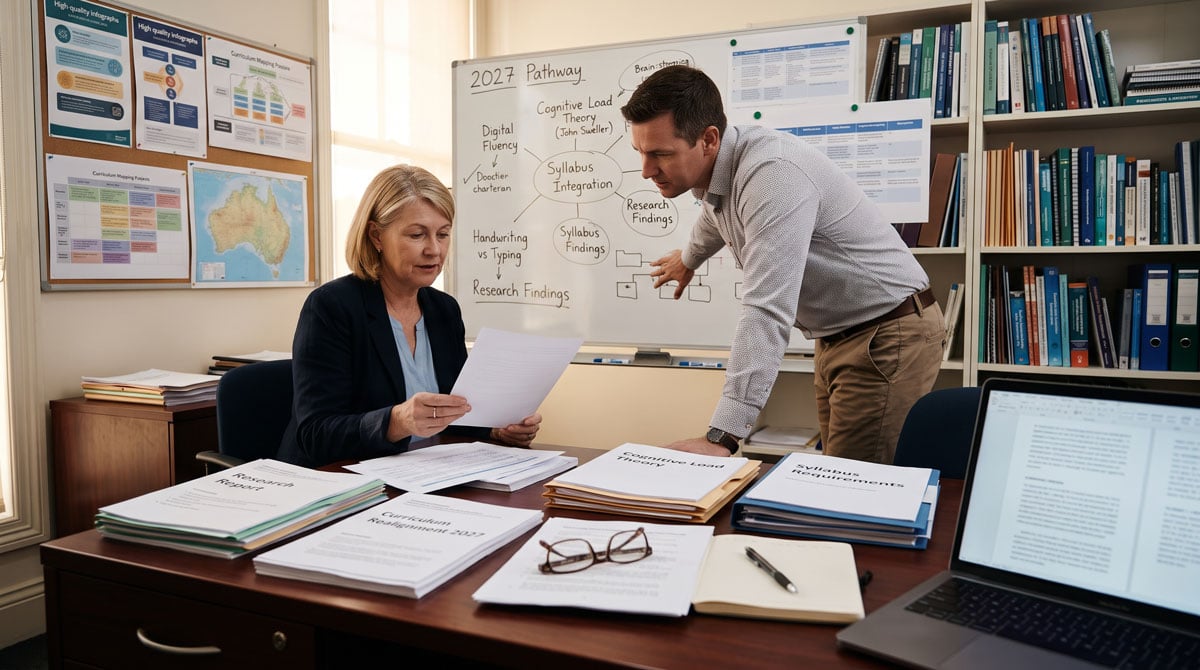
Explore the complete collection of foundational resources below to validate these research findings, examine curriculum alignments in detail, and plan your pathway forward for 2027:
This body of work is entirely unique because it bridges the artificial divide currently splitting education—where academic research, curriculum mandates, and policy-driven screen caps typically remain completely siloed. Rather than treating these elements in isolation, it unites John Sweller’s Cognitive Load Theory, strict syllabus requirements, and breakthrough empirical research into a single, cohesive operational roadmap. By doing so, it provides the practical pedagogical bridge schools need, proving why reducing passive screen time must go hand-in-hand with explicit touch-typing fluency.
Explore these concise summaries to quickly grasp the core insights behind screen-time caps, cognitive science, and the curriculum mandates fo the teaching of typing skills. Each overview serves as a gateway to an in-depth article, empowering you to dive deeper into the research, validate policy alignments, and secure the foundational typing tools your students need.
Uninstructed typing traps students in a 10–15 WPM “hunt-and-peck” loop that drains working memory via Cognitive Load Theory. Synthesizing data from 5,350 students across 99 schools, this paper proves touch-typing fluency (≥18-20 WPM)
yields a +7.1 NAPLAN mark advantage, equivalent to over a term of accelerated writing growth.
Read Full Article
Twenty years of unguided ed-tech experimentation proved that device access is not instruction. While policy documents (ACARA National Curriculum, Victorian Syllabus and NSW Syllabus) mandate keyboarding automaticity by upper primary, teachers report spending only nine minutes weekly teaching it. Schools must bridge this gap with explicit handwriting tools and structured touch typing.
Read Full Article
Media soundbites calling for a blanket return to paper clash with actual state syllabuses requiring dual transcription. Grounded in Sweller’s Cognitive Load Theory, this framework explains how explicit touch typing frees working memory for high-order composition, protecting NAPLAN success, assessment security, and modern workforce readiness.
Read Full Article
NSW’s 2022 English syllabus requires digital transcription from Stage 1, pairing with strict screen-time caps starting in 2027. Cognitive science confirms that automatic keyboarding reduces working memory load and improves writing quality. Structured 10-minute typing sessions make efficient use of device budgets, proving essential for student composition success.
Read Full Article
Political “digital detox” headlines threaten to ban classroom keyboards, but banning screens won’t fix literacy. True literacy requires a research-backed dual-fluency continuum: explicit handwriting in K–2 for motor encoding, paired with structured, ST4S-approved touch-typing via Typing Tournament in Years 3–6 to eliminate cognitive bottlenecks.
Read Full Article
While states implement screen-time caps, typing instruction must not be collateral damage. Keyboarding is a “constrained skill” with a permanent return on investment. By budgeting just 33% of primary screen caps into explicit, ST4S-assessed touch typing, schools can secure a +7.1 NAPLAN advantage without violating time limits.
Read Full Article
As schools navigate 2027 screen caps, leaders must avoid the "zero-sum," "osmosis," and "all screens are equal" myths. Cutting passive screen time is vital, but explicit touch-typing fluency is vital to fulfil the mandatory curricula typing outcomes and from a cognitive science perspective to free working memory and build literacy skills for writing success.
Victorian Curriculum Version 2.0 structures transcription across two registers: explicit handwriting fluency up to Level 2 and progressive digital composition up to Level 6. Supported by cognitive science and tools like Typing Tournament, automatic keystroking ensures students master digital authorship before facing online NAPLAN writing assessments.
Read Full Article
ACARA’s Version 9.0 shifts keyboarding automaticity expectations to Year 4 via the Literacy general capability. Combined with state screen-time caps, early mastery-based typing programs like Typing Tournament optimize restricted device time, ensuring students build essential transcription fluency without violating policy limitations.
Read Full Article