Don’t Let 2028 Fail Another Generation
A briefing on transcription, NAPLAN and the 2028 reversal Graham East — Founder and Managing Director, EdAlive; former primary classroom teacher Disclosure. The author publishes

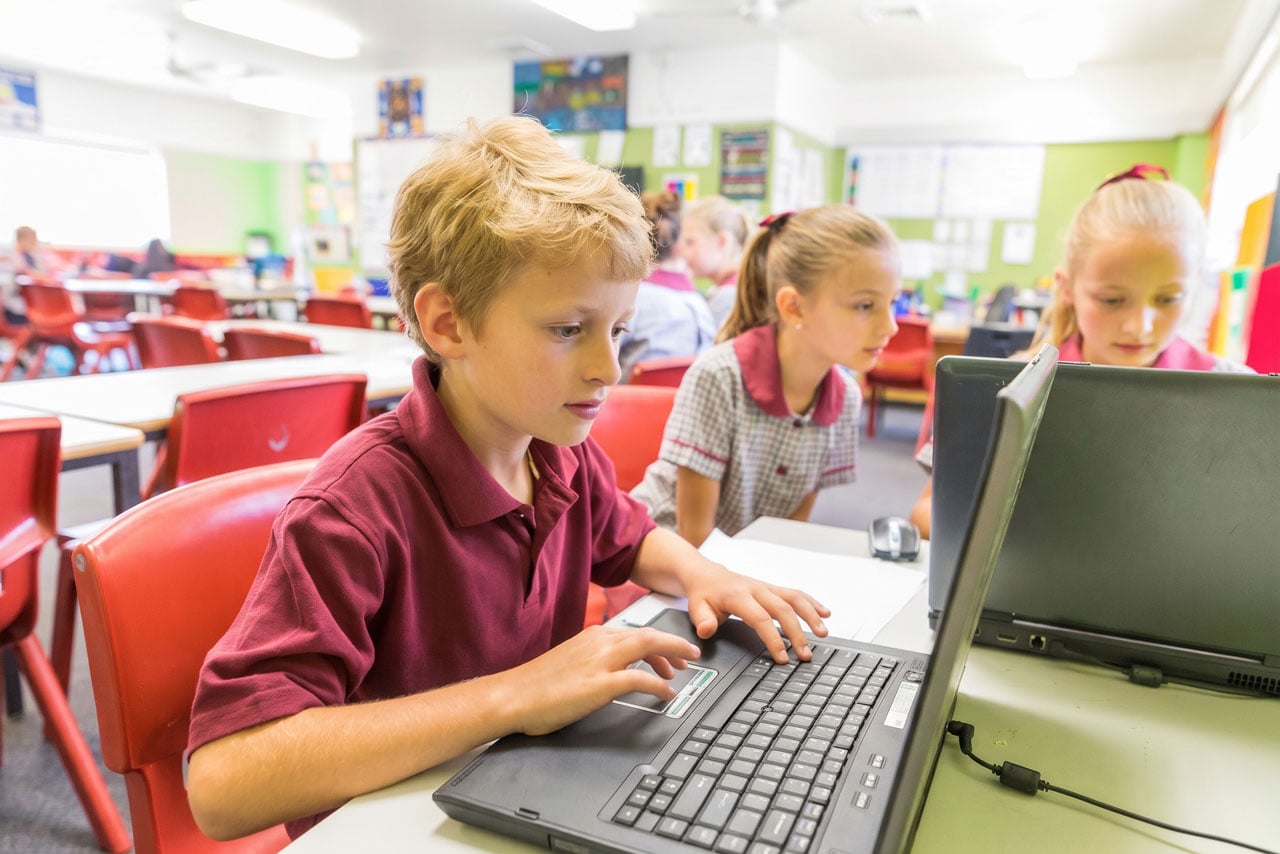
Transcription is not a missing word. New South Wales uses it, and uses it well. The English K–10 Syllabus (2022) contains a discrete focus area called Handwriting and digital transcription, with its own outcomes at Stage 2 and Stage 3 and instructional sequences among the most precise digital-skills documents in Australian schooling (NESA, 2022; NSW Department of Education, 2026; EdAlive, 2026g). They prescribe at least three explicit sessions a week of fifteen to twenty minutes. They name touch typing. They tell teachers to value accuracy over speed. They require students to “reflect on and monitor typing accuracy and rate according to goals and given criteria”. Anyone claiming the syllabus is silent has not read it.
The problem is what happens to the word elsewhere, and what disappears alongside it.
Nationally, ACARA does not use it. The sub-element is called “Handwriting and keyboarding”, and the phrase “touch typing” appears nowhere in the Australian Curriculum at all (ACARA, 2022; EdAlive, 2026f). Keyboarding is the only mandated skill in the curriculum with no named content description in any learning area — the requirement lives entirely inside a general capability, enacted only where a school chooses to write it into planning. English no longer mentions a keyboard even in passing.
Across the country, in every mandatory curriculum document including NSW’s, the same three things are missing: a number, an instrument, and an owner.
NSW’s syllabus tells students to monitor typing rate and accuracy against “goals and given criteria”, while the mandatory syllabus itself sets neither the goals nor the criteria (NESA, 2022). The word arrived; the measurement did not. They were never separable, because a skill named but never quantified has no owner in a system that allocates time by what it can report — and nine minutes a week is what such a skill attracts.
Because nobody measured it in schools, the failure went undetected — until a research unit inside the NSW education department, the Centre for Education Statistics and Evaluation (CESE), tested 1,651 Year 2 to 5 students across 69 schools on both paper-based and computer-based NAPLAN writing tasks, followed by a three-minute typing test (CESE, 2021).
What CESE found should have stopped the national rollout in its tracks:
That is what failing a generation looks like. No scandal, no ministerial statement — just a skill with a name, a syllabus line, and no number attached to it, costing untaught children up to twenty NAPLAN points in a classroom full of the machines that required it. The cohort is specific: the roughly three million students who sat a national writing test on a keyboard between 2018 and now, and were never taught how to use one.
Having found the failure, we have decided not to fix it. In November 2026 ministers agreed that from 2028 the Year 5 NAPLAN writing test returns to pen and paper. Every primary writing assessment in the country will be handwritten, and the only large-scale task in Australian schooling that rewarded fluent typing will vanish. Nothing has been announced to replace it.
We failed that generation. We can still choose not to fail the next.
Keyboard fluency is not a vocational nicety or a clerical residue. It is now the interface through which an adult does most of the things an adult has to do (Alderman, 2004; East & EdAlive, 2026).
Consider what a school-leaver meets within eighteen months of leaving. Tertiary study, where the essay, the report, the discussion post and the online examination are all keyboard-bound, and where “digital by default” submission is not a preference but a platform. Employment, where the survey data has been consistent for two decades: the overwhelming majority of jobs now involve a computer, and the fastest-growing categories involve substantial text production. The administrative state, which has moved almost entirely online — taxation, Centrelink, banking, health records, rental applications, university enrolment, visa forms. None of these has a handwriting option. A person who types at fifteen words a minute can complete them, slowly, resentfully, and with errors; a person at forty-five does them without noticing.
And assessment itself. NAPLAN writing was digital from 2018. Senior secondary certificates increasingly use online examinations and online submission. University assessment is overwhelmingly typed and increasingly invigilated online. Professional accreditation, from teaching to law to medicine, now runs through computer-delivered instruments.
There is one more group for whom this is not an efficiency question but a question of access. For students with dyslexia, dysgraphia, developmental coordination disorder or a motor impairment, the keyboard is not a supplement to handwriting — it is the assistive technology that makes extended composition possible at all. Refusing to teach keyboard fluency does not distribute the cost evenly. It lands hardest on the children for whom it was the only route. That point returns, with force, in §12.
The curriculum already concedes all of this. ACARA’s own NAPLAN guidance states that “ensuring students are familiar with using devices, typing on them and navigating through programs is a part of a student’s learning and a requirement of the Australian Curriculum” (ACARA, 2020). The independent NAPLAN Review Final Report commissioned by four state and territory governments concluded explicitly that “the explicit teaching of keyboarding skills and monitoring typing proficiency beyond Year 3 are essential in developing students’ writing skills and for equitable participation in computer-based writing assessments” (McGaw, Louden, & Wyatt-Smith, 2020, p. 84). NSW recommends three explicit sessions a week. The national Literacy progression carries a terminal descriptor about automaticity in keyboarding.
So, the obligation is not contested. It is merely unspecified. And this is where the failure becomes predictable rather than mysterious, because of a rule every teacher knows and every system exploits: what is assessed gets taught, and what is merely encouraged gets squeezed.
Vagueness is not neutral. It is a licence. A syllabus that says “use digital technologies to create texts” and supplies no mandatory rate, no accuracy standard and no reporting line does not free a teacher to innovate — it frees a school to do nothing, and to be technically compliant while doing it. Nine minutes a week is the rational response of a profession being asked to deliver an unbounded obligation inside a bounded timetable, under an accountability regime that will never ask about it. The vagueness is not a gap in the policy. It is the policy, working exactly as designed.
What pen and paper cannot do
The senior secondary curriculum is where the analogue revival runs out of arguments, because a large share of what Australian students are actually assessed on in Years 11 and 12 has no handwritten equivalent at all. And the most demanding case is not the obvious one.
Design and Technology requires a Major Design Project and a substantial design folio, and the folio is not a document a student types up at the end. It is a working instrument, built in software, structured in grids. Contemporary practice in the subject expects design matrices — criteria listed in rows, competing concepts scored in columns — so that the choice of a final design is evidenced rather than asserted. It expects project management documentation: tasks, timelines, dependencies and Gantt charts. It expects a Bill of Materials, where component names, specifications and suppliers sit alongside quantities and prices in a single table. And it expects data-driven testing, in which qualitative observations (“the user found the handle uncomfortable”) are recorded in the same grid as quantitative measurements — mass, dimensions, user ratings — so the evaluation can be argued from the record.
Read that list again, because it describes a specific and unforgiving cognitive task. A student must produce extended expository prose inside a spreadsheet, while simultaneously managing cell references, formula logic, grid navigation and a second document in CAD. That is not one skill. It is three, layered: keyboard fluency at the base, spreadsheet literacy above it, and document architecture above that. Every one of them is a prerequisite, none of them is formally taught, and all three are being deployed at once in a high-stakes assessment.
The same pattern holds across the senior curriculum. Business Studies requires business reports, financial statements, cash-flow projections, break-even analysis and ratio calculations, much of it built live in a spreadsheet where the cell references are the working. Science practical reports rely on data logging, graphing and statistical analysis in software. Geography uses geographic information systems. English Advanced and Extension run on extended critical essays, drafted, revised and often submitted electronically, in a discipline where students are expected to manage digital sources and their own bibliographies. Software Design and Development, Industrial Technology, Visual Arts and Music all involve submitted works or portfolios with digital components. Underpinning all of it is the plain fact that school-based assessment — the majority of most students’ final marks in several subjects — is now overwhelmingly digital in practice, even where submission rules remain mode-agnostic.
No proponent of the analogue restoration has answered the obvious question. Are they proposing that Design and Technology students hand-draw their CAD? That Business Studies students rule up their spreadsheets on graph paper? That four thousand words of design folio, complete with design matrix and Bill of Materials, be produced in biro? The suggestion is rarely stated outright, because stating it exposes it. What is actually being proposed is stranger still: that these tasks remain digital while the teaching of digital competence is removed from the years in which it is meant to be established.
If primary schools cease to teach keyboarding and to provide timetabled, supervised device access, and secondary schools assume both as prerequisites, then the skill is being abolished in the only window in which it can be built and required in the years when the cognitive load of the content makes building it impossible. A student entering Year 11 at eighteen words per minute — who has never been shown a formula, never built a table, never managed a file structure — will not be taught to type, or to use a spreadsheet, or to structure a folio. They will be taught that school is where you fall behind.
Note also that “typing” is only the first layer. Digital competence is a stack: keyboard fluency at the base, then file and information management, spreadsheets and formulas, referencing and citation tools, data visualisation, collaborative platforms, and — in the Digital Technologies curriculum — data representation, algorithms and implementation, including the web authoring and markup that sit behind the online world students are said to already understand. None of that stack can be built on a foundation that was never laid. A student who has never been taught keyboard fluency, and never had a supervised introduction to the tools of digital production, will not acquire HTML, spreadsheets or citation practice by absorption either. The osmosis assumption does not fail once. It fails all the way up. Osmosis, in this article, means the assumption that a skill is absorbed through exposure rather than taught.
And there is a final irony worth naming. The external HSC examinations remain, for most subjects, pen-and-paper. That is not a defence of the analogue position — it is the clearest evidence of how badly this has been thought through. Students who have spent thirteen years on keyboards without fluency instruction sit handwritten examinations they can barely complete, while the disciplines they study are conducted overwhelmingly in software. Strip devices from primary school and you do not produce students who are fluent with the pen. You produce students who are fluent with neither: unable to produce a design folio, and unable to write four pages by hand in ninety minutes.
Recklessness is the right word for it. A system that removes instruction in a foundational competency from the years designed to deliver it, while continuing to require that competency at every subsequent stage, has not made a policy choice. It has simply stopped doing a job and left the consequences with the children.
The implicit theory was that typing, like swiping and searching, would be absorbed. Children are digital natives; exposure is instruction.
It was falsifiable. It has been falsified three times over — by the 15.4 WPM typing speed figure from the NSW CESE transcription study, by every teacher who has watched a Year 9 student compose an essay with two index fingers and a hunting, pecking stare, and by a 2025 national survey of 340 Australian primary teachers led by Edith Cowan University researcher Anabela Malpique (Malpique, Valcan, Pino-Pasternak, & Ledger, 2025; Malpique & Pino-Pasternak, 2025). More than 98 per cent agreed keyboarding mattered. They reported 31 minutes a week on handwriting and nine minutes a week on keyboarding, against 57 minutes a week in which their students were expected to write texts on digital devices. Seventy-four per cent reported receiving no training in how to teach computer-based writing during their university degrees, and 84 per cent reported little confidence in teaching it.
Osmosis has a ceiling. Children who teach themselves develop hunt-and-peck: they locate each key visually, then reach for it with whichever finger is nearest. The habit stabilises somewhere between 15 and 25 words per minute and then stops — not for want of practice, but because it is a habit that consolidates rather than a skill that improves (EdAlive, 2026a). Adults who never learned still type at the speed of a bright twelve-year-old. Many of them are marking the NAPLAN scripts.
This is not speculation. Connelly, Gee and Walsh (2007) measured handwriting and keyboarding fluency in 300 primary children and compared their compositions in both modes. Handwriting was consistently faster. Only a small minority of Year 5 and Year 6 students typed faster than they wrote. The keyboarded scripts were, in some comparisons, up to two years behind the handwritten ones in developmental quality. Their conclusion was unambiguous: explicit touch-typing instruction is needed to develop keyboarding fluency and unlock the word processor’s potential for children’s writing.
A keyboard nobody has been taught to use does not make writing easier. It makes it worse, and it does so quietly, in a form that looks like a child who can’t write.
The osmosis error has now mutated into its most confident form, and it is being used to justify removing the machines altogether (EdAlive, 2026b, 2026c).
In November 2026 the Sydney Morning Herald reported that Marian Catholic College in Sydney’s north-west will remove laptops and devices from Years 7 to 10 classrooms from next year, one of a small number of NSW schools effectively abandoning one-to-one technology (Harris, 2026). Principal Matthew Smith’s reasoning is candid and, on the distraction question, largely well-evidenced: devices affected focused attention, reduced working memory, and created a barrier between students and teachers, and teenagers proved adept at flicking between applications to disguise what they were doing.
Then he addresses the obvious objection, and his answer is worth quoting in full, because it is the argument the whole country is about to make:
“I do hear the argument that students should have laptops because they have them in the workplace. But he has zero concerns about students’ lack of ‘digital literacy’ because they already spend so much time outside of school on devices. ‘I am more worried about the absence of critical thinking.’” (reported speech)
That is a reasonable inference from a false premise. The premise is that time on devices produces digital skill. The 15.4 figure from the NSW transcription study is what that premise looks like after it has been tested on 1,651 students in 69 schools. Those children were spending an hour a day on school devices and considerably more at home. They typed at half the speed they wrote and lost 15 to 20 NAPLAN points doing it. If exposure produced fluency, the CESE study would have found a different number, and there would have been nothing for this article to be about.
But there is a sharper reason the exposure defence fails in 2026, and it turns on a single fact about what children actually hold in their hands. They are touchscreen natives, not keyboard natives (EdAlive, 2023b). The device a student has at home is overwhelmingly a phone, and a phone does not teach keyboarding. It teaches thumb-typing on a five-centimetre surface, and it teaches it while supplying autocorrect, predictive text and voice input to cover every error. The result is a generation fluent in a mode of input that is useless for the extended text production that school, university, examinations and employment all require — and untaught in the one that is necessary.
Ask a Year 9 student to compose four hundred words on a phone with autocorrect disabled and watch what happens. Then ask the same student to do it on a laptop. The gap between those two performances is the gap between what our schools assume students have absorbed and what they can actually do.
The consequence of the “zero concerns” position is specific and now close. NSW has been phasing out its requirement that public primary students bring their own devices; Victoria is ending BYOD in primary schools from 2027 and capping in-school computer use from Year 3; NSW guidance sets screen time as low as fifteen minutes a day for Year 2 and below, with a minimum of an hour a day of pen-and-paper learning. Ministers have established a Digital Detox Taskforce and restricted generative AI in primary schools. Primary curricula are being rewritten to shift emphasis away from digital skills.
Much of this wind-back of ubiquitous 1:1 laptops and BYOD is defensible, and some of it is producing real gains — schools that have curbed constant screen use report improved attention and stronger results, and there is honest evidence behind the handwriting case set out in §10.
But winding back 1:1 and BYOD creates an immediate practical question that no education department has yet answered: if students no longer carry a personal laptop in their bag, where and how will they be taught essential digital skills?
When 1:1 programmes swept Australian schools after 2008, schools dismantled their dedicated computer labs on the assumption that when every child owns a device, a room full of computers is redundant. What replaced the computer lab was ambient, all-day, low-grade screen use — often on cramped tablet keyboards or laptops balanced on desks with poor ergonomics and zero supervision of technique. In Malpique’s 2025 national survey, only 17 per cent of primary teachers reported that their students even had access to devices with external keyboards in the classroom (Malpique & Pino-Pasternak, 2025).
If schools now remove 1:1 laptops without rebuilding shared, timetabled infrastructure, they will simply replace ubiquitous distraction with total digital neglect. The sensible answer is a return to dedicated computer labs — or properly equipped, bookable class sets with full-sized keyboards — accessed on a fixed timetable for focused, explicitly supervised outcomes (EdAlive, 2023a). For teaching touch typing, a timetabled lab is vastly superior to 1:1 BYOD: every student sits at a proper keyboard, the software is standardised, distractions are locked out, and one vigilant teacher can walk the rows and supervise thirty pairs of hands before the class leaves the machines behind and returns to a distraction-free classroom.
This also clarifies what a “digital detox” should actually mean. The legitimate case for a digital detox is not that all technology should be banished from schooling; it is that unsupervised, wasteful, passive screen access should be curtailed (OECD, 2015; East & EdAlive, 2026; EdAlive, 2026d, 2026e).
When states introduce strict screen-time caps and quotas, every minute of screen allocation becomes precious. Schools can no longer afford to waste forty minutes of their weekly screen quota watching children hunt and peck their way through a three-sentence paragraph. Under a screen-time cap, the rationed minutes must be invested in foundational, high-leverage skills — and the evidence shows that explicit touch-typing instruction is the highest and best use of that quota (EdAlive, 2026d).
Because touch typing is a constrained skill, it does something almost nothing else in the curriculum does: once mastered, it gives time back to the timetable — and cuts the screen time required for every subsequent task.
Consider the in-school arithmetic. A student typing at 15 words per minute needs more than thirty minutes of screen time just to key in a 500-word draft, before a single edit is made. A student taught to type at 40 words per minute keys the same 500 words in twelve and a half minutes. Across every digital research task, essay draft and assignment from Year 4 to Year 12, fluent typists compose faster, finish sooner, and spend less time staring at a screen to produce better work (EdAlive, 2023a, 2026d). Investing forty minutes a week in supervised keyboarding in primary school pays an immediate dividend inside the school timetable — freeing up hours for reading, discussion, and pen-and-paper learning — long before the forty-year career dividend arrives in adulthood.
There is a second force driving the retreat from classroom computers, and it requires the same clear-headed distinction between use and abuse: generative AI.
Schools and ministers are rightly alarmed that unguided access to AI chatbots can hollow out a student’s capacity to research, synthesise information and compose original text. When a student can generate a passable five-paragraph essay from a prompt in four seconds, the temptation to bypass the cognitive struggle of research and writing is immense — and early evidence confirms that habitual cognitive offloading to AI weakens independent reasoning and memory retention.
Ask, however, why students are so quick to offload digital writing to a chatbot. A student who has never been taught to type, who faces a blank screen at 15 words per minute, experiences digital composition as a slow, frustrating mechanical chore. The transcription bottleneck itself incentivises the shortcut.
More fundamentally, just because generative AI poses a genuine risk to student research and composition, it does not follow that digital learning and structured time on devices have no place in schools. Blocking all access and banishing computers from the building is not a strategy; it is a surrender.
If schools want to produce deep thinkers — young adults capable of operating in a complex, technology-saturated world — they cannot do it by pretending the digital world does not exist outside the school gate. A student who never uses a computer at school will still use AI every evening on a mobile phone, with zero guidance on how to verify a source, construct an independent argument, or evaluate machine-generated text. Total elimination does not protect students from AI; it leaves them defenceless in front of it.
To equip students for the world they actually inhabit, schools must build three things in sequence:
You cannot teach the third without the first two, and you cannot teach the second or third by locking the computers in a cupboard. The restitution of the supervised computer lab, and the careful selection of software that builds foundational fluency, promotes original thought and teaches rigorous research skills, is the proper domain of the educator. We are poorly served by a policy approach that mistakes the abandonment of that responsibility for academic rigour.
Without that investment, the child who leaves a “detoxed” system will still face typed university examinations, typed employment assessments, an AI-transformed workplace and a typed administrative life, having been taught neither handwriting fluency, nor keyboard fluency, nor critical digital inquiry. That is not a retreat to rigour. It is the same abandonment with different stationery.
If screen time is strictly capped and every minute on the keyboard must count, the pedagogical design of the software a school puts in front of its students becomes critical. Yet schools that did decide to teach typing didn’t build a programme. They bought one — or bookmarked a free site and called the box ticked.
The market wasn’t built for them. Most typing software targets adult self-learners: people who chose to learn, can diagnose their own errors, and are motivated by the fantasy of finishing in ten easy lessons. Children cannot diagnose their own technique, cannot tell speed from flailing, and will optimise for whatever the game rewards — usually a score, not a skill.
Schools were left choosing between two classes of product, neither designed for a classroom of thirty nor grounded in how children actually acquire motor automaticity.
Ad-funded tutors. Free, and monetised by attention. Frequently no teacher account, no class roster, no longitudinal record, no exportable data — so nobody can answer the only question that matters: is this child better than they were in February? When the product is free, the customer isn’t the school.
Low-cost, gamified subscription tools. A slick interface, thirty levels, a cartoon mascot, and a pedagogy amounting to “practise random words, play an arcade game, get a score”. No explicit teaching sequence. No modelled fingering. No mastery gate. No spaced review. No accuracy threshold. A treadmill with a leaderboard.
Australian education systems have spent the past decade rightly embedding Explicit Instruction and Cognitive Load Theory (Sweller, van Merriënboer, & Paas, 2019) into reading and mathematics. Yet when it comes to keyboarding, schools routinely place children on unguided, “gamified” websites that violate every principle of cognitive science (EdAlive, 2026a, 2026i, 2026j). Dumping a novice in front of full-keyboard word games forces a child to visually scan a hundred-key layout while simultaneously decoding text and managing game mechanics. That floods working memory, induces high intrinsic and extraneous cognitive load, and forces the student to revert to two-finger hunt-and-peck just to survive the game. In fact, when a controlled US study of 1,908 elementary students (Donica, Giroux, & Faust, 2018) measured classes using standard free web-based typing activities over a full school year, upper-elementary students gained barely one to two words per minute.
This is a procurement failure, not a scandal. Schools are not software critics, and we have never given them an evidence standard to tell a genuine instructional tool from a game with a keyboard on it. Every other foundational skill has an evidence apparatus: a national panel, a research review, published efficacy data, a register of approved resources. Keyboarding has a Google search and a staffroom recommendation. The taxpayer funded $2.4 billion of hardware (ANAO, 2011) and let the pedagogy be chosen by whoever was on playground duty in 2013.
Keyboarding is also one of the cheapest interventions available to a school — no excursions, no consumables, no consultants. The gap between a scientifically designed resource and a free, ineffective one is a few dollars per student per year. Under a screen-time cap, wasting precious timetable minutes on a free tool that produces two words per minute a year is the most expensive false economy in schooling.
When time on devices is rationed, a typing tutor must be engineered around Explicit Teaching (I Do, We Do, You Do) and Cognitive Load Management so that motor pathways move rapidly from conscious working memory into long-term procedural memory (EdAlive, 2026a, 2026i, 2026j, 2026k):
Typing Tournament — the programme I publish — was built specifically on those four principles across sixteen graded levels and 128 lessons, drills, games and progress tests (EdAlive, 2026k).
And here is a fact about the international educational software market that policymakers should weigh. Across the globe, not one of the major commercial or freemium web-based typing tutors used in schools has published large-scale empirical efficacy data demonstrating that its system improves student writing assessment outcomes. Even the sole publisher-funded occupational therapy study in the United States (Keyboarding Without Tears; Donica et al., 2018) measured only four schools, did not measure writing outcomes at all, and reported a net advantage of just 1.57 to 2.74 wpm over a school year.
By contrast, EdAlive’s research on Typing Tournament (Brash, 2020; EdAlive, 2020a, 2020b) is — alongside the 2016 NSW CESE trial — one of only two quantitative studies in Australia ever to measure primary student typing speeds against NAPLAN Writing outcomes, and the only study by a typing publisher globally to link its software’s fluency data to a national standardised writing assessment. It should be read with the scepticism any developer-generated data deserves, so I set out both the findings and the limitations.
An analysis of the 2019 Year 5 NAPLAN Writing Task across 99 schools — a Year 5 cohort of about 5,350 from a population of roughly 44,000, spanning all eight jurisdictions, both sectors, metropolitan through remote — compared each school to its own “Similar Schools” benchmark, the NAPLAN construct adjusting for socio-economic advantage, sector, size and remoteness. Classes were included only where they used the programme consistently and reached a class average of at least 18 wpm — roughly where typing matches or exceeds primary handwriting, which the report notes averages 10–13 wpm (Brash, 2020).
69 of 99 schools sat at or above their benchmark, with an average margin of +7.1 NAPLAN writing marks (p = 0.000002) — in score terms roughly 1.1 to 1.6 school terms, in a single sitting. The margin held across the socio-economic range, sector (government +6.95, non-government +7.23) and location (metropolitan +6.52, non-metro +8.24). Internal longitudinal logging across thousands of classes shows students using the explicit sequence weekly gain an average of 6 words per minute per term — over 20 wpm in a single year, roughly ten times the gain recorded by free web-based activities (EdAlive, 2019).
Notice how closely the two Australian datasets converge. In the NSW CESE trial, untaught Year 5 students averaged 15.4 wpm and suffered a 15-to-20-point online penalty, recovering 7.5 points for every +5 wpm of speed (CESE, 2021). In the EdAlive analysis of live NAPLAN testing, classes taught to 18+ wpm erased the penalty and outperformed their socio-economic peers by 7.1 marks (Brash, 2020).
The limitations of the EdAlive study are real. Not peer-reviewed — conducted and published by the developer. Cohort-level, not student-level, so it cannot show that the fastest typists wrote best; the report says so itself. The sample skews upward: its Similar Schools mean sat 10.9 marks above the national average (p = 0.00001), and the author states it “was not a random representation of Australian schools”, with lower geo-ethno-socio-economic strata under-represented.
Against that, weigh what the analysis is. Conducted by Dr Lindsay Brash, a statistician, on a dataset rare in keyboarding research — where the literature typically rests on a few hundred students, and several foundational studies used samples of twenty or fewer. It uses NAPLAN’s own covariate-adjusted benchmark rather than a convenient comparison. It discloses its selection bias rather than concealing it. It concedes its own decisive limitation.
And note what it exposes: neither ACARA nor any international typing tutor vendor has published a single study of live national writing assessment scores against student typing speed. A small Australian software publisher had to do it themselves.
The number that should end the “too hard” objection is not in the NAPLAN analysis. It is in the weekly class leaderboards — and it is 40 words per minute, a measure of typing speed that should not be confused with the forty minutes of weekly tuition needed to build it.
Typing Tournament publishes a weekly class leaderboard drawn from schools running the programme regularly (EdAlive, 2026l), and those leaderboards routinely show class averages above 40 words per minute (wpm) — not the top class in the country, not a selective school, but ordinary mixed-ability primary and secondary classes, on four or five short sessions a week (EdAlive, 2019, 2026l). This matches the pattern of individually documented cases, including a Year 5 class at St Mary’s School in Dubbo, NSW, that moved by 23 wpm from roughly 20 wpm to a class average of 43.43 wpm in a single year on eight to ten minutes a day (Alexander & East, 2019).
Treat this as internal publisher data and weigh it accordingly. But its significance is structural rather than statistical. It relocates the question. The American speed benchmarks — 27 wpm at grade 6 in Utah, 35 wpm in Nebraska’s middle years, 30 to 50 wpm across Texas districts — now stop being an aspirational import from a strange jurisdiction and become the same order of magnitude as outcomes being produced in Australian classrooms, this term, by ordinary teachers running a well-designed, explicit scope and sequence. A class average of 40 words per minute is not a stretch target. It is what a class looks like after a year of doing the work on a cognitively sound programme.
That reframes the fluency threshold that follows: if 40 wpm is readily attainable, then the 18–20 wpm speed at which the NAPLAN advantage appears is not a ceiling to be reached with difficulty. It is the first landing on a staircase most classes should be able to climb well past.
One finding matters more than the rest and has the weakest evidentiary base of any claim here.
Brash (2020) identified 18 words per minute as the point at which the NAPLAN advantage appeared — and, more usefully, found that beyond it additional speed produced no further gain. That is not a linear relationship. It is a saturating one: benefit accrues until transcription stops consuming attention, then stops accruing. The shape of the curve is what the cognitive-load account predicts, and it is consistent with CESE’s finding that a modest speed increase of 10 to 13 wpm is enough to close the 15-to-20-point gap between paper and screen (CESE, 2021).
It is also the load-bearing number for everything proposed here. It sets where a Year 5 benchmark sits. It defines what “fluent” means for reporting. It determines whether a school has succeeded. If the threshold is 20 wpm, a school at 22 is finished; if it is 35, that school has barely begun.
| Established | Not established |
| A threshold exists: below some speed, transcription taxes working memory | The precise value of the threshold across all year levels |
| Untaught keyboarding plateaus at 15–25 wpm — costing 15–20 NAPLAN points in primary | Whether it varies by task type or accuracy weighting |
| Explicit instruction produces rapid gains (+7.5 pts per 5 wpm); 40 wpm class averages are attainable in a year | Whether the curve is a sharp step, a plateau or a slow saturation |
| Benefit appears to saturate once typing overtakes handwriting speed | The exact saturation point in student-level live NAPLAN data |
The evidence for the exact cut-off remains thin because official bodies refused to study it. The EdAlive analysis is the only Australian source that quantifies a threshold against live NAPLAN outcomes, supported by CESE’s 2016 trial data. The peer-reviewed keyboarding literature establishes that instruction works and that osmosis plateaus (Malpique, Asil, Pino-Pasternak, Ledger, & Teo, 2024, 2025). It does not establish where the line falls.
That is a genuine gap and should be named as one. It must not become a reason to wait.
The existence of a threshold is not in serious doubt. Every account of automaticity in writing — the handwriting literature, the cognitive-load research, NSW’s own guidance that automating mechanics frees resources for text creation — rests on the same claim: below some speed transcription taxes thought, above it, it does not. What is uncertain is the exact value, not the mechanism.
So, the answer is a provisional benchmark and a funded research mandate, in that order. Set the Year 5 target in the 20–25 wpm range at 95 per cent accuracy — defensible on both CESE and EdAlive evidence, achievable by a school running three sessions a week, and in the band the American jurisdictions independently occupy. Commission the study that would refine it: longitudinal, with student-level typing data, student-level writing outcomes, and a designed test of the curve’s shape. Publish, then adjust. That is how every other benchmark in the curriculum was set.
Declining to set a number until a perfect study arrives is not neutrality. It is the precise move that produced the last fifteen years, and it can be repeated indefinitely.
If forty words per minute is the attainable speed, forty minutes a week of tuition is the modest time investment required to reach it — provided an adult is actually watching. No procurement reform fixes the supervision problem.
Even a well-designed programme has a ceiling, and the ceiling is the human in the room. As EdAlive’s own classroom practice documentation states plainly: the software “cannot determine which fingers are being used on which keys. Ultimately only a vigilant teacher, teacher’s aide or other supervisor can ensure that students use the right fingers on the right keys” (EdAlive, 2023a, 2023b). Software sees what was typed; it cannot see how. It cannot see that the child has drifted off the home row, that the left hand is crossing to the right side of the keyboard, that the eyes never leave the keys. Software teaches key location. Only a person teaches key technique — and technique is the difference between learning to touch type and learning to hunt and peck faster.
The research has known this for nearly forty years. Stoecker (1988) reported that non-typists default to two fingers unless a teacher observes. Russin’s (1995) comparison of teacher-directed and software instruction found that after twenty lessons not one student in either group could key without looking at their fingers, and only a handful used correct fingering at all, supporting Kimball and Lane’s (1989, as cited in Russin, 1995) observation that it is extremely difficult to learn the touch method once bad habits have formed. Mikkelsen and Gerlach (1988) found supervised and unsupervised groups progressed at similar rates on a tutorial and concluded that software alone does not ensure proper keystroking technique — arguably the more damning finding, since it suggests the tutorials did the same thing whether or not an adult was present.
The characteristic Australian keyboarding lesson is thirty or forty children, a trolley or a lab, a programme loaded, and a teacher marking, planning, answering email, or surviving a workload that makes forty minutes of close hand-observation impossible. The students play the game. The game reports progress. The school reports that keyboarding is taught.
The diagnostic question costs nothing: can the child type with the keyboard covered? In most Year 7 and 8 classrooms the great majority cannot. They have completed level after level. They have never once typed without looking. The dashboard said they were progressing the whole time.
This is worse than doing nothing, because bad habits consolidate (Oelhman & East, 2017; EdAlive, 2023b). Visual-guided two-finger typing does not wait for correction; it entrenches, plateaus between fifteen and twenty-five words per minute, and becomes actively resistant to unlearning. A child who has “done typing” for four years and types at 18 wpm is not a beginner. They are a damaged case, and repair costs more than instruction would have. We have spent their practice time on the wrong technique.
What the Dubbo class did was not exotic: short, frequent sessions rather than one long block, which is what spaced practice would prescribe anyway. And one other thing. The teacher, Dennis Alexander, ran a one-minute speed test every Friday, read the report himself, built a class leaderboard from it, and set individual targets with the children (Alexander & East, 2019).
The active ingredient was not the software. It was adult attention. Those children improved because someone was watching.
Keyboarding therefore cannot be fixed by a purchase order and a bookmark. It is a staffing and workload question dressed up as an IT question. If we want technique taught, someone has to stand behind thirty pairs of hands and say, “ring finger, not index”, three times a week, for four years. We have made the room available. We have made the software available. We have never made the attention available.
The absence of numbers is the structural failure, and it is stranger than it looks, because transcription is the most measurable thing in the entire curriculum.
Nobody can put a reliable number on a Year 6 student’s capacity for literary interpretation. Anyone can put one on their handwriting speed with a stopwatch and a standard passage, and on their typing speed with a three-minute copy task and a keystroke log. These are among the few literacy skills with near-perfect inter-rater reliability and no construct ambiguity whatsoever. We measure them in research as a matter of routine. We decline to measure them in schools.
Instead, the curriculum uses adjectives.
ACARA calls handwriting and keyboarding a constrained skill — one of the few things in literacy that can be taught to mastery in a bounded amount of time and then requires no further instruction (ACARA, 2022; EdAlive, 2026f). Exactly the kind of skill a curriculum should pin down with numbers, because you can. The sub-element runs across eight levels, and the terminal one — P8 in the current version, HwK8 in the last — says the student “demonstrates automaticity when using keyboarding and screen functions”.
Automatic how fast? To what accuracy? Judged when, by whom, reported where? None of it is specified, and none of it has to be, because the descriptor is qualitative and therefore unfalsifiable.
| What the curriculum says | What two minutes would establish |
| “demonstrates automaticity when using keyboarding” | net words per minute; accuracy percentage |
| “maintains legibility, fluency and automaticity in handwriting” | letters per minute; legibility against a rubric |
| “monitors typing accuracy and rate according to goals and given criteria” | the goals; the criteria; the rate achieved |
| “selects digital technologies to suit audience and purpose” | speed and accuracy in the selected mode |
| “demonstrates efficiency” | a number, or nothing |
Two details make the vagueness worse. In the current version English no longer names a keyboard at all: the v8.4 content description that at least referenced use of software has been deleted, and students are now asked to “plan, create, edit and publish” without specification of the machine. And while ACARA is careful to say its progression levels carry “no suggested timeframe”, the alignment it publishes places P8 — automaticity — at Year 4 (ACARA, 2022; EdAlive, 2026f). In the previous version the same indicator was labelled Years 5 and 6. The deadline moved two years earlier, nothing was mapped beyond it, and the weekly allocation remained nine minutes.
NSW does better, and the comparison is instructive rather than flattering. Its focus area names the skill. Its sequences name touch typing. Its guidance is more explicit than anything ACARA has published. Yet the mandatory NESA syllabus asks students to monitor typing rate and accuracy “according to goals and given criteria” while supplying neither (NESA, 2022) — and the Department’s non-mandatory Stage 3 sequence mentions “35 wpm… with a low error rate (for example, 98% accuracy)” only as a parenthetical illustration before instructing ten-year-olds to invent their own individual SMART goals from their baseline (NSW Department of Education, 2026, p. 22). There is no state benchmark, no mandatory target rate, no accuracy standard, and nothing to report against.
The word is present, the pedagogy is present, the mandatory number is absent — and in a crowded curriculum, a thing without a required number is a suggestion.
Victoria’s English Version 2.0 carries no discrete transcription focus area of the kind NSW built, organising writing under a single “creating texts” sub-strand, with no rate or accuracy requirement in either mode (VCAA, 2024; EdAlive, 2026h).
The United States has no national curriculum, so its expectations are scattered. Where Americans decide something matters, they write down a number and then check it.
| Where | What is required |
| Utah (rule R277-700-4(6)) | Assess keyboarding proficiency by end of grade 5 and report school-level results to the state superintendent by 1 June annually. Touch keying introduced K–2. Technique graded, including “eyes on copy or screen, not on keys”. Secondary minimum 27 wpm at grade 6, no more than two errors a minute. A state keyboarding specialist and teacher endorsement course (Utah State Board of Education, 2023). |
| Texas (Technology Applications TEKS, 2022) | Grade 6 must “demonstrate improvement in speed and accuracy as measured by words per minute” applying correct technique (Texas Education Agency, 2022). |
| Nebraska (model scope and sequence) | 20 lessons a year of 20–30 minutes from grade 4; middle-school target 35 wpm at 90% accuracy (Nebraska Department of Education, 2019). |
| Common Core states | Grade 4: type “a minimum of one page in a single sitting”. Grade 5: two. Grade 6: three (NGA & CCSSO, 2010). |
| Australia (P8) | “Demonstrates automaticity when using keyboarding and screen functions.” No number. No measure. No report (ACARA, 2022). |
Some districts go further: one in Texas publishes end-of-year benchmarks of 30 wpm by grade 6, 35 by grade 7, 40 by grade 8 and 50 by grade 12.
Argue about whether 27 or 30 or 40 is right. What cannot be argued is that a system publishing a number, assessing against it, reporting it and training teachers to deliver it is having the same conversation, from an empirical base, as one that writes “automaticity” and moves on.
But now we are not having the conversation at all. We are having a conversation about screens.
The temptation now is to pick a side. Handwriting was neglected, so restore handwriting. Typing was never taught, so teach typing. Pick one, resource it, stop arguing.
That framing is the trap, and it is the one we are walking into (EdAlive, 2026b).
First, and this must be said without hedging: handwriting is not a legacy convenience being defended out of sentiment. It does specific work in literacy development, and that work is not a matter of aesthetics.
Explicit handwriting instruction improves letter recognition, legibility (ES = 0.59), fluency (ES = 0.63), composition quality (ES = 0.84) and composition length (ES = 1.33), not merely the appearance of the page (Santangelo & Graham, 2016). Neuroimaging work with pre-literate five-year-old children finds that handwriting — and specifically printing letters by hand, not tracing and not typing — recruits the left fusiform gyrus and reading-associated neural circuitry during subsequent letter perception, producing activation patterns closer to those of mature readers (James & Engelhardt, 2012). And in the largest study of its kind (N = 4,950 primary students across Grades 1 to 3), handwriting fluency uniquely predicted the quality of children’s compositions after controlling for attitude, language background, gender, grade and school (Skar et al., 2022) — the cognitive-load mechanism of this article operating in the other modality.
None of that is an argument against the keyboard. It is an argument against treating either mode as self-teaching. It is also the reason this article will not join the chorus that says handwriting was a casualty worth accepting. It was not a casualty worth accepting. It was a casualty of a reform that had no theory of transcription at all, and the children who lost it lost something real.
Australia’s own research says neither mode wins by default. A meta-analysis pooling 22 studies and 6,168 primary students found passages written by hand were of higher quality than keyboarded ones, with a moderate effect of ES = 0.53 (Malpique, Valcan, Pino-Pasternak, Ledger, & Merga, 2024). Connelly et al. (2007) found the same. Note what that establishes and what it does not. It does not establish that handwriting is the better mode for a literate adult. It establishes that an untaught keyboard is worse than a taught hand — a mode in which the child carries the full mechanical cost and gets none of the benefit — and in a primary classroom where one mode has been explicitly taught for four years and the other has not been taught at all, that is the comparison the research is actually making. Indeed, when Malpique and colleagues (2024, 2025) measured 544 Australian Year 2 students across 47 classrooms, keyboarding automaticity uniquely predicted both the quality and the productivity of children’s computer-based writing beyond spelling, reading and gender.
And the handwriting case has a credible independent voice, which matters more than anything a publisher can say. Charles Sturt University’s Adjunct Associate Professor Noella Mackenzie, welcoming the shift back to pen and paper, identified precisely the failure this article describes: “We’ve gone so far down the digital road in schools … handwriting drops off around year 3 and students fail to develop an efficient, automated style” (as cited in Harris, 2026). Her diagnosis of the children is exact — the hybrid of handwriting and typing in primary meant students entered high school without being proficient in either.
That is the whole thesis, from an academic with no commercial interest, in one sentence.
We did not abolish handwriting; we stopped defending it. Primary teachers still give it half an hour a week, and the evidence for explicit instruction is strong. Then students reach secondary school, where handwriting becomes what you do when the laptop trolley is booked, and where the institution’s quiet message — the assignments, the submission portals, “you’ll type it up anyway” — is that the hand is a legacy interface.
So, we produced a generation that automated neither mode. Not fast enough at the keyboard to think through it; no longer practised enough with a pen to think through that either. Boys and girls who generate ideas at the speed of speech and transcribe them at the speed of a hesitant walk.
This is a cognitive-load problem before it is an aesthetic one. Writing is a competition for working memory: the idea, the sentence, the spelling, the syntax, the audience — and underneath all of it, the mechanics. Until the mechanics are automatic, they take the share of attention the thinking needs. NSW’s own guidance states the principle precisely: automating the mechanical aspects of writing frees cognitive resources for text creation (NSW Department of Education, 2026). Fluency is not a nice-to-have that arrives after the real work. It is what makes the real work possible.
The goal is not a mode. The goal is dual fluency: automaticity in both handwriting and keyboarding, benchmarked, taught and reported, so neither becomes the gate through which a child’s intelligence has to squeeze (EdAlive, 2026b).
Three qualifications, or the phrase will be adopted by systems that then change nothing — exactly what happened to “automaticity”. It requires numbers, or it is a slogan. It is not symmetrical in time — handwriting is foundational in the early years and does specific developmental work there; keyboarding should be introduced from Year 2 or 3 and both maintained to Year 10. Dual fluency is the destination, not the timetable, and anyone who hears “both modes, always, equally” will use it against early handwriting instruction, which would be a disaster. And it is a claim about automaticity, not literacy. A Year 9 student typing at 18 wpm and writing at twelve words a minute is not illiterate. They are transcription-poor, and the cost is a cognitive tax on every extended task they attempt. That distinction is what makes the argument unanswerable rather than merely loud. “These children can’t write” is a claim about knowledge, and it is false. “These children cannot transcribe fast enough for their thinking to survive the journey to the page” is a claim about automaticity, and it is demonstrably true.
We are not arguing for the pen against the keyboard. We are arguing that a system which taught neither, then blamed the tool, should teach both — and check.
On Monday 2 November 2026 ministers agreed the Year 5 NAPLAN writing test returns to pen and paper from 2028, meaning every primary writing assessment will be handwritten, since Year 3 already is (Duffy, 2026; Australian Financial Review, 2026). NSW, whose minister Prue Car has led the push, wants Years 7 and 9 to follow, with ACARA to advise. Ministers also agreed to a national “digital detox”, a Digital Detox Taskforce, screen-time limits to be set or considered, and restrictions on generative AI in primary schools and secondary assessment.
The case is not stupid. Australia’s most recent PISA results were its worst, and Australian students reported 2.6 hours a day on devices at school against an OECD average of 1.7. Ministers are responding to something real: parents who feel the tablet has eaten their child’s attention, teachers who watch students flinch at a blank page, and a genuine body of evidence that handwriting does specific work in early literacy — the evidence set out in §10. Car puts it plainly: “It’s about the evidence of how children learn and they actually do better when they’re writing pen to paper as opposed to typing on screen” (as cited in Duffy, 2026).
The mechanism is the problem, and so is the evidentiary vacuum on which the decision rests.
The national writing test moved online from 2018, fully digital by 2022. From that moment every Year 5, 7 and 9 student in the country had to compose extended prose on a keyboard, in a timed sitting, for a score that would be reported and compared. It was never a typing test. But it was the only large-scale task in Australian schooling where fluent keyboarding paid off — the only place the system’s incentives quietly rewarded schools for teaching the skill and punished those that didn’t.
We are about to remove it and replace it with nothing.
If the writing test returns to paper, no jurisdiction will assess typed composition at scale. Handwriting will be assessed; handwriting will, in effect, be what counts. Schools respond rationally to what counts — that is the same law that produced nine minutes a week. Within one planning cycle, “digital transcription” becomes the focus area that gets the last ten minutes of a Friday afternoon, or nothing.
So, we complete a perfect circle. First, we digitised the classroom and refused to teach the digital skill. Then, having found that untaught digital skills produce bad outcomes, we remove the digital task rather than teach the skill. And now, in the third movement, we describe the removal as a return to rigour while the timetable stays empty.
One awkward fact, without overclaiming: when the August 2026 NAPLAN results landed, reading was down in every tested year level, writing was a particular concern in Years 3 and 5 — and Year 5 was the only year group whose writing improved (AAP News, 2026). One dataset, not causal, possibly noise. But the cohort being moved back to paper is the one that was, in the most recent national measurement available, the only one moving the right way.
How did Australian education authorities justify running a high-stakes keyboarded writing exam for eight years without teaching typing — only to abruptly abandon it now?
For years, ACARA’s official NAPLAN FAQ has stated:
“The writing test is not about handwriting skills and NAPLAN is not about keyboarding skills. There are variations in how fast and well a student can type, just as there are variations in how fast and well a student can write by hand… Students do not have to be able to touch type to successfully complete the test.” (ACARA, 2020)
In the same document ACARA asserted that familiarity with typing is “a requirement of the Australian Curriculum.”
Ask the obvious question: where is the research ACARA published to prove that typing speed does not affect NAPLAN writing scores?
There isn’t any. Audit ACARA’s official NAPLAN Online Research and Development repository (nap.edu.au; ACARA, 2026). It lists thirteen research reports across six categories: Tailored test development, Automated essay scoring, Device suitability, Student engagement and motivation, Readability and layout, and Accessibility options. Not one of those published studies measures student typing speed in words per minute against NAPLAN Writing marks. ACARA’s summary report mentions a 2012 pilot in a single paragraph, asserts without data that online delivery “would not substantially change the assessment properties”, and relies on student engagement interviews noting that “no students reported feeling penalised for typing their responses” (Lazendic, Justus, & Rabinowitz, 2014, p. 3). Eleven-year-olds did not feel penalised, so the national authority declared there was no penalty.
In fact, across the entire history of NAPLAN Online, no Australian education authority — except the NSW CESE team in its 2016 trial — has ever published a study measuring student typing speed against NAPLAN writing scores. And when NSW CESE did measure it, it proved ACARA’s claim false: untaught typing cost primary students 15 to 20 NAPLAN points, and every 5 wpm of typing speed recovered 7.5 points (β= 1.5, p < .001; CESE, 2021). Yet CESE’s recommendation was not to abandon online testing for Year 5. Its recommendation was explicit: “Given the importance of typing proficiency for computer-based writing assessments, schools should… identify an effective method for developing students’ typing fluency and to monitor the development of their typing proficiency over time, for students beyond Year 3” (CESE, 2021, p. 6; echoed in McGaw et al., 2020, p. 84).
When NAPLAN went live online in 2018, no government authority followed up to measure what happened to the schools that did teach typing versus the schools that didn’t. The only study ever conducted on live operational NAPLAN Online Writing results and typing fluency is the self-funded research by EdAlive using Typing Tournament data (Brash, 2020) — which found the exact +7.1-mark advantage CESE’s trial predicted.
Look at the two consequences of that official obfuscation:
First the authority denied without evidence that the skill mattered. Now ministers are abolishing the task without evidence. In both directions, the student was left untaught.
There is a fairness argument here that has been made almost entirely from one side, and it needs to be made from both.
The online era was not neutral. From 2018 to 2026, NAPLAN writing was a timed composition on a keyboard. A student who typed at forty words per minute had a materially different task from a student who typed at fifteen. One had twenty-five minutes of thinking time; the other had ten. As the CESE data proved, that speed gap translated directly into 7.5 NAPLAN points for every 5 words per minute, and it fell hardest on boys, Aboriginal students, and low-SES schools with lower technical readiness (CESE, 2021). The marking rubric did not mention this, the reporting did not disclose it, and ACARA denied it was happening.
The children who benefited were those who had a keyboard at home before school, a parent who could type, or a school that had chosen to teach the skill properly. When this article says typing is now a class marker, this is the mechanism: a skill distributed by postcode, converting quietly into marks.
The return to paper does not correct that. It relocates it.
A handwritten test is a timed composition by hand. It will reward students whose handwriting is fast and automatic, and it will penalise students whose handwriting is slow, effortful or illegible — regardless of how well they think, and regardless of how fluently they type.
| Regime | Who is advantaged | Who is throttled |
| Keyboarded (2018–2026) | taught to type at home or at school; keyboard-rich households | untaught typists; device-poor students; students taught handwriting only |
| Handwritten (2028–) | fluent handwriters; strong fine-motor development | students with dysgraphia or motor difficulties; slow handwriters; students whose primary writing mode since Year 3 has been a keyboard |
Consider who sits in the second row of the second column. Students with dysgraphia. Students with developmental coordination disorder, hypermobility or fine-motor delay. Students whose handwriting is slow and painful while their typing is fluent and unremarkable — the very students ACARA’s own Northern Territory trial noted “found it easier to engage with the task online because typing reduced their anxiety in producing legible pieces of writing” (Lazendic et al., 2014, p. 11). Add to them the students in schools that issued devices from Year 3 and treated the pen as optional, who have had years of keyboard practice and almost none of the other kind. Some of these children are excellent writers. Under a handwritten assessment, their transcription difficulty will be read as a composition deficit and scored accordingly.
Reasonable adjustments exist — extra time, a scribe, a laptop. They are not nothing, and schools use them. But they are discretionary, they require a diagnosis and an advocate, they vary by school and by state, and they are applied to a task whose default assumes a mode the child may not have. An adjustment is what you offer when the assessment was designed for somebody else. It is not the same as an assessment designed for everybody.
There is a genuine counterargument, and it deserves to be stated rather than buried: paper is cheap, universal, needs no device, no charging trolley and no IT support, and in a country with persistent digital access gaps that is a real equity virtue. That argument is sound, and it is an argument about equity of access. It is not an argument about equity of assessment. Making the test cheap and universal does not make it fair to the child whose hand cannot keep up.
Which is why the answer to a discrimination problem is not to pick the other side of the same coin. Every single-mode assessment throttles some group of children, and the group changes when the mode changes. We have now run the experiment twice, in opposite directions, and each time we have called the resulting score a measure of writing.
The only design that stops laundering one mode’s difficulty into another mode’s mark is to measure both, and to report both, so that a child who thinks well and transcribes badly in one mode is visible rather than mislabelled. That is not a compromise between two positions. It is the only position that does not require choosing which children to disadvantage.
The answer is not “keep the typing test online”. We should assess both transcription modes explicitly and should have done so since 2018.
Every NAPLAN writing score in Australia is a composition score multiplied by a transcription score, and only one of them is measured. A student who thinks well and types badly and one who thinks badly and types well can receive the same mark, and nobody — marker, parent, system — can tell them apart. That is a validity problem at the centre of the country’s most scrutinised literacy assessment. A transcription measure does not add a test. It rescues the interpretation of the test we already have.
We accepted this logic once already. Language Conventions exists as a separate instrument precisely because we decided you cannot read composition quality off a script contaminated by spelling ability. We separated spelling, grammar and punctuation from writing decades ago. We left the mechanics of producing the letters and keystrokes fused into the writing score — unmeasured, unreported — then drew conclusions about a generation’s writing from it.
| Component | Mode | Measures | Marking |
| Writing (as now) | Paper from 2028 | Composition | Human |
| Language Conventions (as now) | Paper from 2028 | Spelling, grammar, punctuation | Human/automated |
| Transcription — keyboarding (new) | Online, 3 min, Years 5 and 9 | Net wpm, accuracy | Fully automatic |
| Transcription — handwriting (new) | Paper, 1 min, Years 3 and 5 | Letters per minute, legibility | Rubric, sampled moderation |
The keyboarding task should be a three-minute timed copy of year-appropriate sentences on equivalent unseen forms — deliberately the same method as the CESE study, so every result is comparable to the 15.4 wpm baseline (CESE, 2021). The instrument already exists and has been trialled on 1,651 students. The platform computes net wpm and accuracy with no human involvement and captures revision and pause behaviour at no extra cost. It would be the only NAPLAN component that marks itself — worth saying loudly to anyone who objects that NAPLAN is overloaded.
The results should then be reported at school-level to schools and at system level publicly, with no child-level publication, no league tables, no gatekeeping on progression. The purpose is to make the invisible visible, not to rank eleven-year-olds. Utah has run this model for decades without collapsing.
The symmetry requirement matters as much as the keyboarding task, and for the reasons set out in §12. A keyboarding measure alone would invert the imbalance and make typing the only measured mode. The paper test should carry a one-minute handwriting sample — letters per minute plus legibility. Handwriting fluency is currently required by NAPLAN and never scored; slow handwriters are penalised invisibly and nobody can identify them. Mackenzie’s point is the same one: you cannot fix an automated style nobody ever taught or measured.
Both writing tasks should remain at Year 9: one handwritten, one typed. A child whose score moves twenty marks between modes has a transcription problem — now visible, now fixable. That is the diagnostic that fifteen years of unmeasured transcription made impossible, and it is also the fairest thing the system could do, because it stops asking which mode’s casualties we prefer.
Two objections, each answerable in a sentence. “You’re testing keyboards instead of thinking.” No — we are testing the thing that currently prevents us knowing whether a child can think, and which NAPLAN already tests by default every time it hands out a pen. “Typing is obsolete in the age of AI and dictation.” Then so is handwriting, and ministers mandating one for cognitive reasons cannot coherently dismiss the other; as §4 sets out, a student who cannot fluently compose and edit their own text at a keyboard cannot critically command AI tools either. In any case, the exam hall and the shared desk are not places where a person can talk to their computer — and if ever there were, that argument would cut against the pen just as hard.
There is a political irony worth naming. If writing returns to paper, ministers will need something to show they have not abandoned digital capability. A three-minute, auto-scored, zero-marking-cost transcription task is the cheapest possible answer. Unusually for a political fix, it is also the correct policy.
A twenty-word-per-minute deficit is not only a school-timetable problem. It is a fifty-year problem.
Start in the classroom. A Year 9 student has forty minutes for 500 words. At 20 wpm the keystrokes consume 25 minutes, leaving fifteen for thinking and revising. At 45 wpm — ordinary, on the evidence above — the same words take 11 minutes, leaving twenty-nine. Same intelligence, roughly double the room to think, and less than half the screen time required to finish the task.
| Australian school leaver (typical) | Benchmark US school leaver | |
| Exit speed | 15–25 wpm | 40–50 wpm |
| 1,500-word report | 60–100 min | 30–38 min |
| Words in a 2-hour drafting block | 1,800–3,000 | 4,800–6,000 |
Now extrapolate across adulthood, with the assumptions stated, because the point depends on them: a forty-year working life; 220 working days a year; and only one hour a day in which output is genuinely bound by hand speed. A quarter of a standard day, almost certainly an underestimate for most professional, clerical and technical occupations.
A person typing at 20 wpm produces in those 220 hours what a 45-wpm typist does in 97.8 hours (220 × 20 / 45 = 97.8). The saving is 122 hours a year; over a career, 4,889 hours, or about 2.7 full working years at 1,840 hours a year. At two keyboard-bound hours a day, roughly five.
This is not a claim that fast typists work harder or produce 60 per cent more. It is that the same output costs them 44 per cent less time, and that time goes somewhere: a second draft, a phone call, going home at six instead of seven. Efficiency doesn’t make people work more. It makes what they do less expensive in the one currency nobody gets back.
This is not a marginal cohort. Around 300,000 students leave Australian schools each year. At 122 hours each, that cohort carries a hidden tax of about 36 million hours annually — roughly 20,000 full-time workers’ worth of lost capacity, every year, until they retire.
The American comparison is not about smarter children. It is about a written number and someone who checks it. Their students leave school typing at double to triple our speed, then compound the advantage for forty years. Two adults in the same job will not differ by 25 words per minute. They will differ by years.
No inquiry. No framework, no roadmap, no strategy with a logo. Five decisions and about an hour a week.
1. Put numbers in the curriculum — for both modes. Replace “demonstrates automaticity” with benchmarks in the Literacy progression and English achievement standards. A floor, not a finishing line:
Provisional by design. The Year 5 target should be set in the 20–25 wpm band at 95 per cent accuracy on current evidence, and revisited once a funded study establishes the threshold properly. A benchmark that can be revised is worth more than a number that is never set.
Nothing ambitious here. Forty words per minute is what ordinary Australian classes already produce within a year. And the fluency point that generated the seven-mark advantage was 18–20 wpm — the first landing, not the summit.
2. Timetable it — short, frequent, supervised, and in dedicated labs or class sets. Fifteen to twenty minutes, three to five times a week, Years 3 to 6, allocated as the first priority of a school’s screen-time quota. As schools wind back 1:1 laptops and primary BYOD, reinstate timetabled computer labs or bookable class sets with full-sized keyboards so classes enter a controlled environment for focused instruction — building foundational typing, structured digital research, original composition, and later critical AI literacy under teacher supervision — before leaving the screens behind. Supervision must be written into the requirement, not left to goodwill: a keyboarding lesson without an adult checking fingering is screen time with a dashboard. Fund aide time in the early years and put technique checks — can the student type with the keys covered? — into the scope and sequence.
3. Assess both modes explicitly and make adjustments structural. Three minutes of auto-scored keyboarding at Years 5 and 9. One minute of rubric-scored handwriting at Years 3 and 5. Two Year 9 writing tasks, one by hand and one by keyboard, so that the mode effect is measured per student rather than assumed away. Report no league tables. And where a student’s two transcription profiles differ substantially, report that difference as information for the school rather than as a deficit for the child — so that a motor difficulty is identified as a motor difficulty and not silently recorded as weak writing.
4. Train the teachers, in technique as well as software. Most of the workforce was never taught to teach keyboarding, and many cannot touch type. A national micro-credential, a scope and sequence, and a requirement in initial teacher education would fix in five years what otherwise drifts for fifteen. Include the diagnostic: eyes off the keys, hands on the home row, screen covered.
5. Procure against a national evidence standard grounded in Explicit Instruction and Cognitive Load Theory. Educators should curate software that builds foundational skills, promotes original thought and teaches genuine research capability rather than cognitive offloading. When screen time is capped, schools cannot waste rationed minutes on gamified or ad-funded websites whose publishers have never published a shred of efficacy data on writing outcomes. Minimum criteria for typing software: a systematic explicit teaching sequence (I Do, We Do, You Do) introducing keys incrementally to manage cognitive load; modelled biomechanics and fingering; accuracy-gated mastery progression; spaced deliberate practice; per-student longitudinal records and diagnostic reporting; curriculum alignment; no advertising; no secondary use of children’s data; and published empirical efficacy data. If a product cannot tell a teacher whether a child improved since February — or if its publisher has never measured whether the software works — it is not a teaching tool and should not be bought with school money or allocated a minute of a school’s screen quota. The standard should not stop at typing software. Spreadsheets, CAD packages, referencing tools and the learning management system are instruments of assessment now, and each deserves the scrutiny we would give the curriculum it serves.
Then say it in every syllabus document, so nobody can pretend they didn’t hear it:
A student who cannot transcribe fluently in both handwriting and keyboarding is not literate for the world they live in.
The digital revolution did not fail because we put laptops in classrooms. It failed because we mistook the arrival of a tool for the acquisition of a skill — and then, confronted with the wreckage, began to blame the tool.
The same mistake is queued up in the other direction. A retreat to paper, on its own, is not a remedy. It is the same abandonment with different stationery. Fail one generation by accident and it is a tragedy. Fail the next one on purpose, in full possession of the evidence, and it is a choice — and 2028 is that choice, made in advance, on the record, by people who will not be in the room when it lands.
Two things must be held together, and the failure of the last fifteen years was the failure to hold them together. Handwriting matters more than the reformers who abandoned it believed, and it was not defended properly when it should have been. Typing matters more than the reformers who assumed it was absorbed believed, and it was never taught at all. Neither claim is weakened by the other. They are the same claim, applied twice: transcription is a skill, skills must be taught, and what is not measured is not taught.
The implications of the argument set out in this paper are far-reaching. They touch the validity of our national assessment system, the cognitive load placed on every child who sits down to write, the equity of access for students with motor and learning difficulties, the return on billions of dollars of public infrastructure, and the forty-year productivity of the Australian workforce.
For fifteen years, Australian education authorities implemented sweeping changes to classroom technology and assessment on the basis of unverified assumptions — asserting that children would learn to type by osmosis, and declaring without a single published study that typing ability had no bearing on NAPLAN writing scores. Now, in 2026, authorities are moving to implement an equally sweeping reversal for 2028 on an almost non-existent evidentiary base.
That is no longer acceptable. This paper has placed its evidence, its sources, and its methodological limitations on the public record alongside the NSW Department of Education’s own CESE findings and the international peer-reviewed literature. The onus is now squarely on those implementing change — ministers, curriculum authorities, and education departments — to validate their decisions through rigorous, published research. If any authority, policymaker, researcher, or publisher differs from the positions or recommendations set out here, the challenge is simple: support that difference with empirical evidence. Australian students cannot afford another decade of policy by assertion.
“Zero concerns” is the sentence that should worry us most, because it is said in good faith by people of goodwill who have correctly diagnosed the distraction and incorrectly concluded that skill is free. It is not free. It was never free. The 15.4 wpm figure from the NSW CESE transcription study is what the price looks like when nobody pays it.
We have not failed a generation because we gave them screens. We have failed them because we gave them screens and then acted as though the hands would take care of themselves — and we are about to make the same mistake with a pencil.
Somewhere in a Year 9 classroom right now a student is composing an essay with two fingers, one idea ahead of their hands and three ideas behind their own intelligence. Somewhere in the same room is another student whose hands cannot form the letters fast enough to keep up with an argument they could have made brilliantly. They are not lazy. They are not distracted. They were given every advantage of the digital age except the forty minutes a week that would have made any of it usable.
Teach them to type. Teach them to write. Measure both. We owe them that, and it is overdue by a generation.
Graham East has spent nearly fifty years in Australian education as a classroom teacher, special-needs and differentiated-learning practitioner, educational technologist, and software publisher. Trained at the North Brisbane College of Advanced Education, he taught for twelve years in Queensland state schools and at St Andrew’s School in Walkerville, South Australia, where he specialised in middle-primary education and supporting children with learning difficulties. In 1984 he established one of Australia’s earliest primary-school computing programmes, using Apple II computers to help Year 4 students with severe writing difficulties compose and edit text.
In 1986, together with his wife Barbara, he founded New Horizons Educational Computing Services (relocating to Armidale, NSW, in 1989), where for twelve years he edited the New Horizons Educational Computing Magazine for more than 20,000 Australian teachers. In 1995 he founded EdAlive, which has since produced and published more than 60 curriculum-aligned educational titles — including Typing Tournament, Maths Invaders, Words Rock and ZooWhiz — winning over 60 international and national awards and serving more than 10,000 schools and one million learners across Australia, New Zealand, the United Kingdom and the United States.
Competing publishers, researchers, and education authorities are invited to reply to this paper; responses will be published in full, and those who differ from its conclusions are invited to present the empirical evidence supporting their position. Generative AI tools were used under the author’s direction to assist with primary-source auditing, synthesis, and drafting; all citations and data have been verified against primary records. Research referenced here is available on request from EdAlive (www.edalive.com).
References have been verified against primary publications where available; official curriculum documents are cited by title and instrument number.